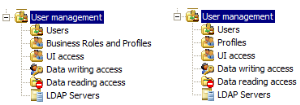
Accessing User Management and UI Access Management Folders (Windows Front-End)
This section describes how to access management windows for users, profiles, and business roles.
Accessing User Management and UI Access Management Folders (Windows Front-End)
The
User management folder contains all sub-folders for management of
users, that is:
To access user management and UI access management folders:
1. From MEGA Administration, connect to the environment concerned.
2. Expand the User management folder of the environment.
From the User management folder of an environment you can access management windows:
• of Users
User characteristics are defined in the following tabs:
• Persons
• Person Groups
• Logins
• of Business Roles and Profiles
(case of assignment of business roles to persons)
• of Profiles
(case of definition of profiles on login of persons)
• of UI access
Object UI access and general UI access are characteristics defined in tabs:
• Object UIs
• General UIs
Opening the user management window (Windows Front-End)
Characteristics of
users are managed in the
Userswindow.
To manage users:
1. From MEGA Administration, connect to the environment concerned.
2. Expand the User management folder of the environment.
3. Right-click the Users folder and select Manage.
The Users window opens.
The Users window contains tabs:
• Persons, listing all persons in the environment and detailing personal characteristics of each person.
• Person Groups, listing all person groups in the environment and detailing their characteristics.
• Logins, listing all users in the environment and detailing their characteristics and access rights to MEGA repositories.
From the Users management window you can:
• create:
• persons
• user management
• user groups
• configure characteristics:
• of a person
• of a person group
• of a login
• delete users
• modify:
• user properties
• user passwords
• access user options
Opening the profile management window (Windows Front-End)
To manage profiles:
1. From MEGA Administration, connect to the environment concerned.
2. Expand the User management folder of the environment.
3. Right-click the Profiles folder and select Manage.
The Profiles window opens.
The Profiles window of an environment enables management of user profiles. It lists all environment profiles and details for each profile the products that are accessible (optional).
To be able to connect, a user must have at least one profile or business role depending on the selected operating mode (see
"Managing Profiles and Business Roles"). Users with the same profile share common characteristics (options, repository access rights, authorized products, read/write and read-only rights on objects).
From the Profiles management window you can:
• create profiles
• consult profile characteristics
• configure profiles
• connect users to profiles
• delete profiles
Opening the business roles and profiles management window (Windows Front-End)
To manage business roles and profiles:
1. From MEGA Administration, connect to the environment concerned.
2. Expand the User management folder of the environment.
3. Right-click the Business Roles and Profiles folder and select Manage.
The Business Roles and Profiles window opens.
The Business Roles and Profiles window enables management of user business roles and profiles.
The tab:
• Business Roles lists all business roles in the environment and details the associated profile for each business role used for connection.
• Profiles lists all environment profiles and specifies for each profile the products that are accessible.
Each user must have at least one business role connected to a profile. Users with the same profile share common characteristics (options, repository access rights, authorized products, read/write and read-only rights on objects).
From the:
• Business Roles tab you can:
• create a Business Role
• consult Business Role characteristics
• configure Business Roles
• assign Business Roles to Persons
• delete Business Roles
• Profiles tab you can:
• create profiles
• consult profile characteristics
• configure profiles
• connect users to profiles
• delete profiles
 See "Connecting to an Environment", page 5.