Performing an Advanced Search in ERQL Mode
To perform an advanced search in ERQL mode:
1. Open the advanced query tool.
The advanced search tool appears.
 You can use the Wizard to enter your query; see Performing an advanced search in ERQL Mode with the help of the wizard mode.
2. Click the ERQL mode pane.
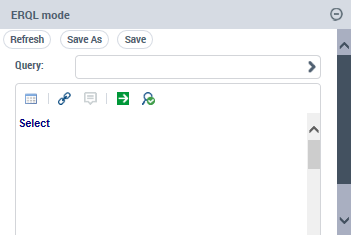
3. Enter your query.
For more information on ERQL language (query syntax and conditions), see Query Syntax.Example: "Select Org-Unit Where Name like "#agent#" finds org-units whose name contains agent.
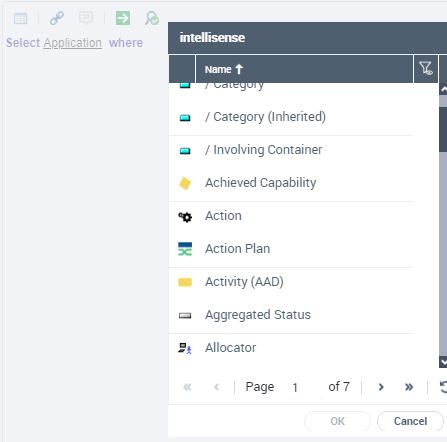
You can use the IntelliSense feature to enter your query:
• Press <Ctrl> + <Space> to display the list of eligible object types.
To extend/restrict the object types displayed in the list, see Extending/Restricting the object types queried.• Select an object type to complete your query.
Abstract objects are prefixed with [A] and are listed after the concrete objects in the IntelliSense tool.Computed links are prefixed with the / character and are first listed in the IntelliSense tool.
4. (Optional) Click Analyze  to test the syntax of your request.
to test the syntax of your request.5. Click Process  to run the search.
to run the search.The result list is displayed.
6. Select the object you want to consult.
You can export the list in Excel formatYou can launch an instant report from the list, see Launching an instant report from a list.To return to your search, in the breadcrumb trail, click Advanced Search. If needed, you can modify it.Performing an advanced search in ERQL Mode with the help of the wizard mode
To simplify data entry, you can build a query from the wizard mode.
To perform an advanced search in ERQL Mode with the help of the wizard mode:
1. Open the advanced query tool.
The advanced search tool appears.
2. In the Select an object type field, use the drop-down menu to select the object type to which your search relates.
3. In the Wizard Mode pane, select the search parameters.
4. When you have selected your parameters, select the ERQL mode pane.
5. In the command bar of the ERQL mode pane, click Refresh.
The syntax of the query appears.
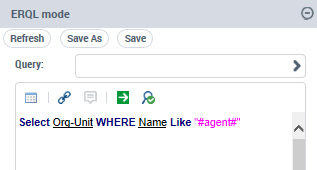
6. Complete the syntax.
You can use the IntelliSense feature to complete your code:
• Press <Ctrl> + <Space> to display the list of eligible object types.
To extend/restrict the object types displayed in the list, see Extending/Restricting the object types queried.• Select an object type to complete your code.
Abstract objects are prefixed with [A] and are listed after the concrete objects in the IntelliSense tool.Computed links are prefixed with the / character and are first listed in the IntelliSense tool.
7. (Optional) Click Analyze to test the syntax of your request.
to test the syntax of your request.8. Click Process to run the search.
to run the search.The result list is displayed.
You can export the list in Excel formatYou can launch an instant report from the list, see Launching an instant report from a list.To return to your search, in the breadcrumb trail, click Advanced Search. If needed, you can modify it.Saving an ERQL query
You can save an ERQL query to make it available in the registered queries.
To save an ERQL query:
1. Define your ERQL query.
2. Click Save As.
3. In the Name field, enter a name for your query.
4. In the Stereotype field, select the query type.
See Query type.5. Click Next to reread the code of your query.
6. Click OK.
Your query is available in the Registered Queries pane.