The Interface Elements
The interface presents the elements specific to the profile with which you are connected.
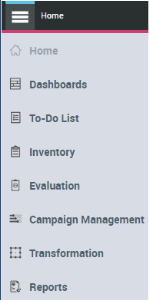
Navigation menu and panes
The navigation

menu gives access to navigation panes that vary according to the solution and the connection profile.
The navigation panes correspond to the various types of objects or various steps of a project.
Example
In HOPEX IT Portfolio Management, the desktop visible to the application portfolio manager presents the navigation panes for the main steps of application portfolio management: inventory, evaluation, , etc.
When you select a navigation pane, a list of specific objects appear in the pane.
Example
For example, click on the Inventory pane to access the types of objects that make up the application assets: applications, technologies, portfolios, etc., categorized according to different criteria:
• All applications of the repository
• The applications outside of a portfolio
• Applications without owner
• etc.
Navigation panes common to HOPEX profiles
Most HOPEX profiles have access to the following navigation panes:
• Dashboards : displays the list of indicators required to steer objects such as processes, applications or org-units. See
"Customizing your Dashboard".
• List of tasks: displays the tasks assigned to the user.
• Reports: presents a set of dynamic reports that enable repository data analysis according to different perspectives.
Query toolbar
Main menu
The Main Menu gives access to actions that concern:
• dispatch
• collaborative work
• the advanced search
• import/export tools

See the documentation related to each of them.
• the mapping editor
• user options
• Online documentation, which enables access to user and technical HOPEX documentation as well as a search tool
Edit Area
The edit area is used to perform business and technical operations proposed by the selected Solution.
In the edit area, you can display the list of objects, the detail of objects, their diagrams, analysis reports, etc.