HOPEX in a Multilingual Context
Knowledge sharing is possible across the company and in different languages through multilingual support: repository content is managed and published in as many languages as required.
HOPEX allows you to enter data in several languages.
You can easily switch from one language to another to enter or consult data, or to generate documents.
Managing the Data Language
HOPEX allows you to enter data in several languages. You can switch from one language to another to enter or consult data or to generate documents.
Defining the available languages
HOPEX supports more than 30 data languages: Arabic, Bosnian, Bulgarian, Chinese (Simplified), Chinese (Traditional), Croatian, Czech, Danish, Dutch, English, Spanish, Finnish, French, Greek, Hebrew, Hungarian, Icelandic, Indonesian, Italian, Japanese, Korean, Malay, Norwegian, Polish, Portuguese, Romanian, Russian, Serbian, Slovak, Slovenian, Swedish, Thai, Turkish, Vietnamese
Prerequisite: the data language in which you want to work is installed in HOPEX.
 To configure the list of available work languages, see Installing Additional Languages.
To make a language available, you must activate it:
1. In your HOPEX desktop, access your Options (Main Menu > Settings > Options).
2. In the Options tree, select Installation > Languages.
3. In the right pane, select the language.
4. Click OK.
The language is available in the Main menu > <current language> > <language name>.
Modifying the data language
In HOPEX, you can switch from one language to an other as you need.
To modify the data language in HOPEX:
1. In your HOPEX desktop, click Main Menu  .
.
.2. Select <current language> > <new language>.
The data (translated) appear directly in the selected language.
To identify untranslated data, see Viewing Untranslated Objects.Entering Data in Several Languages
Prerequisites to the manual translation of data
To manually translate your data:
• Check that the languages in which you want to translate your data are available.
• Check that the General > Translation property page is available.
By default this page is not displayed in the Solutions.To display the Translation page:
1. Access options (Main Menu > Settings > Options).
2. In the Options tree, select Installation > Languages.
3. In the right pane, select the Presentation of translations option
The General > Translation property page is available for all the repository objects.
Object characteristics in the target language
You can define the object characteristics in a target language.
E.g.: its name.
To enter an object characteristics in a target language:
1. Access the object properties.
2. Display the General > Translation page.
If you cannot see the General tab by default, access the property pages list to select it. See Showing/Hiding pages.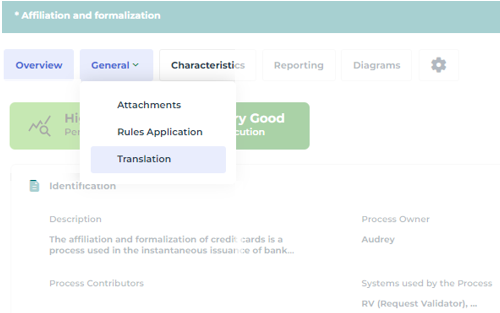
3. In the Translation pane, in the Name field, enter the name of the object in the corresponding target language.
You can enter the name of the object in all of the available languages.The Date of language update of the modified data is then updated on the General > Administration page, Administration section.
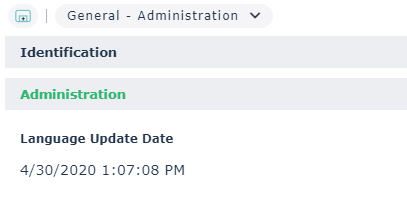
Data whose translation in a given language has been entered manually can no longer be translated automatically per batch in this language. Only interactive automatic translation is possible.
For more details, see Using Automatic Translation for Data.Object Description in the target language
To enter the object description in another language:
1. Access the object properties.
2. Display the General > Translation page.
Each target language has a Description (<language>) tab.
3. Select the target language tab, i.e.: the tab of the language into which you want to translate your original text.
4. Enter your text.
You can use editing tools.Multilingualism and duplicated object names
When you duplicate an object, it must be in the repository language so that translations in the various languages will be correctly transferred to the duplicates.
To determine the language of your repository, consult the repository properties.For more details on duplication, see Duplicating Objects.Viewing Untranslated Objects
When you change the data language:
• Objects translated are displayed in the selected language.
• Objects untranslated are displayed in their creation language.
The Indication of objects not translated option enables to add as suffix to untranslated object names, the corresponding language code (for example, FR for French).
<data in its creation language> (<creation language code>)
Example: Étudier le crédit (FR).
To add a suffix to untranslated object names:
1. Access the HOPEX options (Main Menu > Settings > Options).
2. In the Options tree, select Installation > Languages.
3. In the right pane, select Indication of objects not translated.
The corresponding language code is added as a suffix to the untranslated object names.
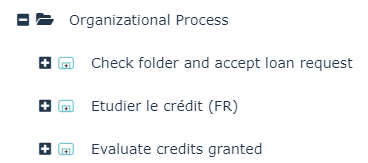
In the above example, applications have been created in English and have to be translated into the current language (French in this example).