Handling a Graph
A graph illustrates relationships between objects. These relationships can be grouped to highlight the relationship density between certain objects.
The graph includes facilities to optimize its readability and customize its display.
You can:
• improve the graph readability:
• hide or reduce the length of labels
• hide isolated objects
• modify the object spacing
• focus on an object
• choose the analysis criteria (layers)
• ungroup grouped relationships
• highlight an object (style)
• modify the graph style
You can also:
• perform searches to find objects in the graph
• zoom in on and move about in the graph
• display the graph in 3D
• display the properties available in tooltips
• access object properties
• access the object pop-up menu (right-clicking the object)
Improving a graph readability
To improve a graph readability:
1. (If needed) Zoom in on and move about in the graph.
2. Below the graph, select Options  and move the cursors:
and move the cursors:• Label Length, to the left to reduce or to the right to increase the character numbers of the labels.
• Object Spacing, to the left to narrow the object spacing or to the right to increase the object spacing.
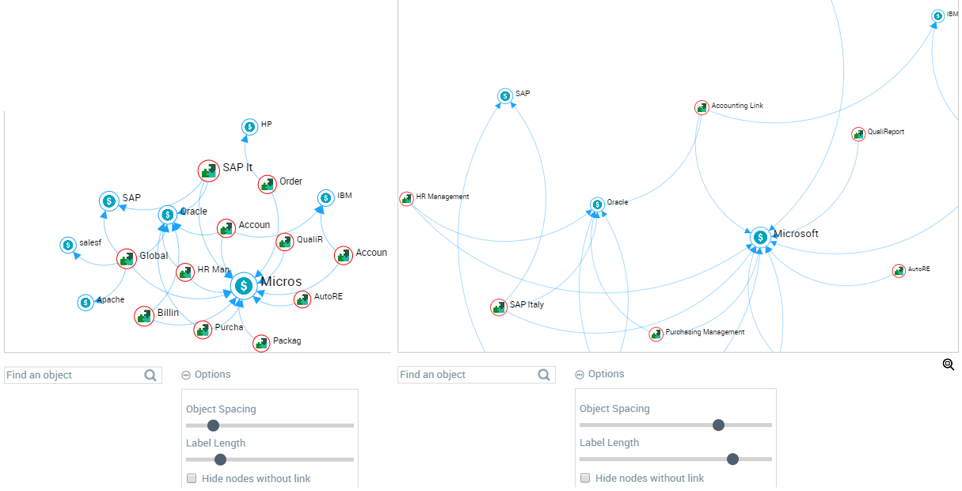
3. To isolate an object (display it with its direct relationships), roll the mouse over the object, and in the tool-tip, next to its name, click Focus  .
.
.The selected object is isolated.
 Click in the graph to return to the entire graph display.
4. To hide the isolated objects (nodes), below the graph, select Options and Hide nodes without link.
and Hide nodes without link.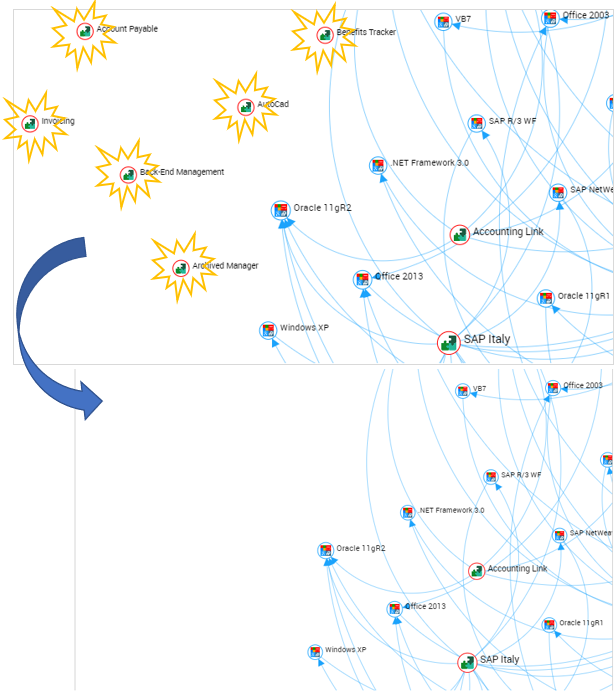
Displaying a graph analysis criterion
When a graph contains several analysis criteria, you can restrict its display to a single active layer.
That way, you can quickly switch from an analysis criterion to another one or overlay them.
To choose the analysis criteria to be displayed:
 Above the graph, click Layers and select the analysis criteria that you want to display.
The cleared analysis criteria are hidden.
Beside Layers,  indicates that analysis criteria are filtered.
indicates that analysis criteria are filtered.
Finding an object in the graph
To find an object in the graph.
1. Below the graph, in the Find an Object field, enter a character string.
E.g.: enter "man".
The objects that do not contain the character string entered are automatically grayed.
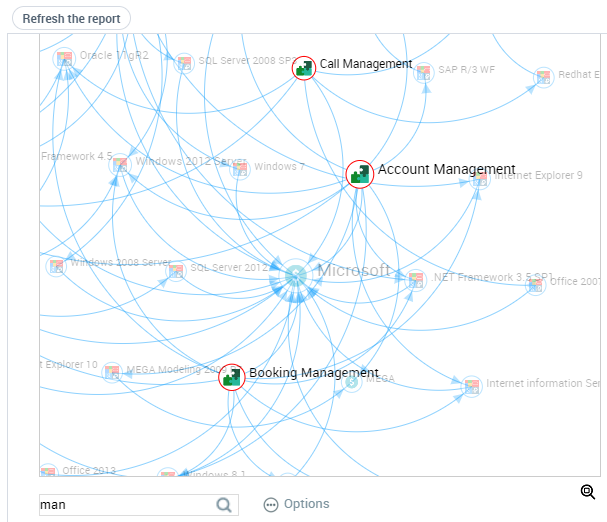
2. To display all the objects again, click Refresh the report.
Zooming in on and moving about in a graph
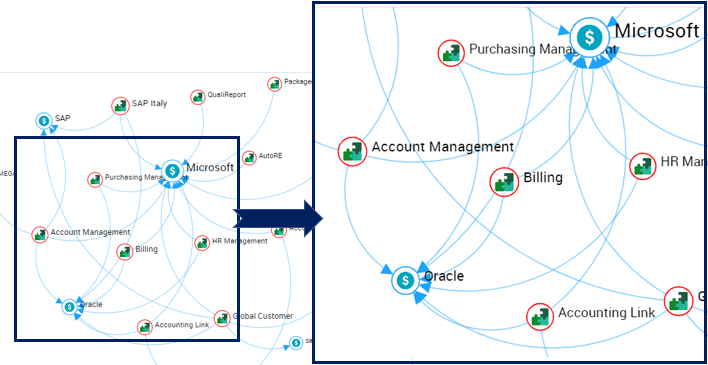
To zoom in on and move about in a graph:
1. In the graph, use the mouse wheel to zoom in/zoom out.
The zoom is performed on the graph as a whole.
To focus on a single object in the graph, see Improving a graph readability.2. (if necessary) To move about within the chart, click the chart (outside an object), keep the mouse button pressed and move the mouse.
To find an object in the graph, see Finding an object in the graph.Displaying a graph in 3D
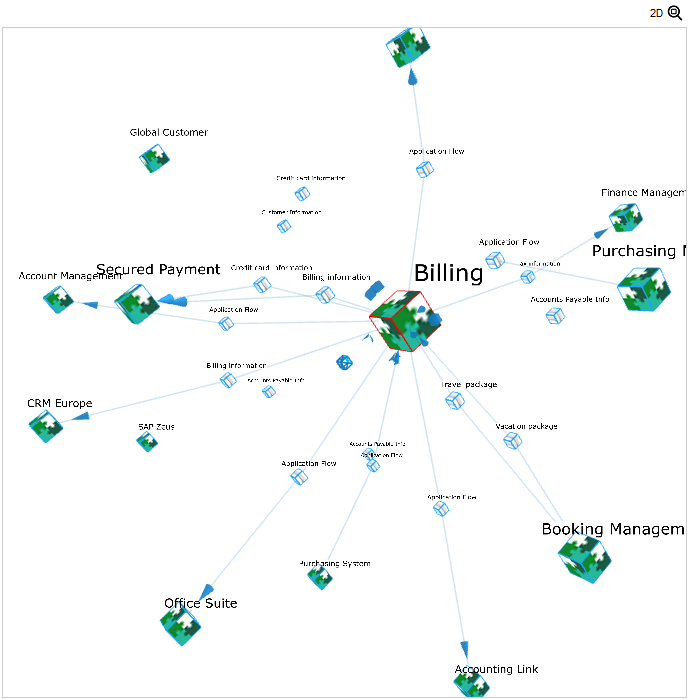
To display a graph in 3D:
1. Above the graph, click 3D.
The 2D button replaces the 3D button.
The graph is displayed in 3D.
To return to 2D, click 2D.2. If needed:
• Click in the graph and move the mouse so as to make the elements more readable.
• Focus on another object to highlight another object.
Handling a relationship grouping
In a graph, relationships between two objects can be grouped. A relationship grouping is identified by its stroke thickness. The strokes standing for relationships are called arcs.
E.g.: the arc between "Payroll" and "Accounting" stands for a relationship grouping.
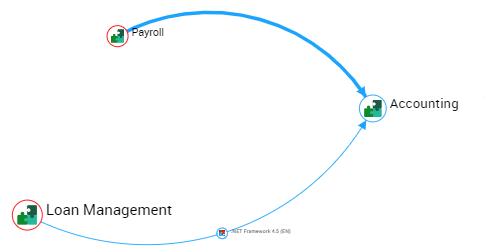
You can:
• display the number of arcs included in the grouping
• ungroup arcs to display their intermediate objects
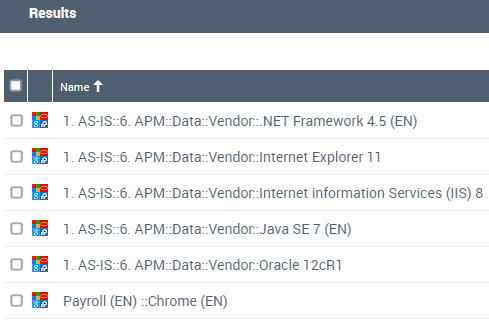
• simply display the list of intermediate objects
To handle an arc grouping:
1. (If needed) In the graph, find and/or isolate an object for more readability.
2. Roll the mouse over the arc grouping.
A tooltip displays the number of arcs included in the grouping.
Example: the arc grouping between "Payroll" and "Accounting" stands for six arcs.
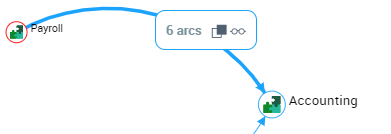
3. You can:
• display the arcs of the grouping and their objects: click Ungroup arcs  .
.
. To regroup the arcs, roll the mouse over one of the arcs and click Group arcs  .
.E.g.: each arc between "Payroll" and "Accounting” includes one intermediate object (the grouping includes six intermediate objects).

• simply list the intermediate objects in the Results window: click Click to view details  .
.
.
Displaying the properties available in tooltips
Tooltips enable to display the properties available on:
• an object
• a relationship
• an intermediate object (object included in a relationship)
To display the properties available in tooltips in a graph:
1. Access the graph, and if needed find and/or isolate an object for more readability.
2. Roll the mouse:
• over the object concerned to display its available properties.
• over the relationship concerned to display its available properties.
• over the intermediate object concerned to display its available properties.
A maximum of five properties are displayed, click Display more  to display more (if any).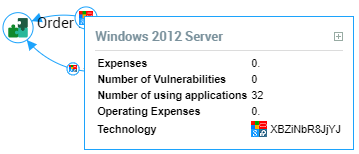
Displaying an object properties
You can display an object properties:
• In the Properties window  , which enables to switch from an object properties to another one easily.
, which enables to switch from an object properties to another one easily.• in a pop-up window (right-click the object).