Handling Lists
Repository objects are often presented as lists of objects of the same type.
 Repository objects are often represented as trees of objects of the same type as well, see Handling Trees.
In lists, you can customize the display of columns and data.
Defining the columns to display
Each column corresponds to an object characteristic. You can select the columns that you want to show or hide.
To display or hide one or several columns:
1. In your HOPEX desktop, access the list of objects.
 For example, click the “Applications” navigation menu.
2. Hover the cursor over the column header and click More  .
.
.3. Hover the cursor over Columns and select the columns you want to display.
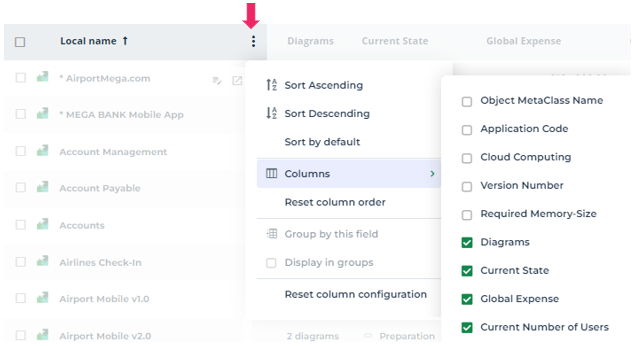 To hide a column, clear the corresponding check box.
Modifying the column width
Each column width is adapted to its content.
When you modify a column width:
• the width gets locked
• the width of the column is saved in your customization parameters
To modify the width of a column:
1. In your HOPEX desktop, access the list of objects.
2. Click one of the column header dividers and drag the divider to the desired width.
The width of the column is modified and saved.
To return to the default value, see Resetting column configuration or Resetting your Desktop Customizations.Modifying the column order
To modify the column order:
1. In your HOPEX desktop, access the list of objects.
2. Click in the column header and drag-and-drop the column to the required location.
A green cursor indicates that the chosen position is authorized.
The order of the columns is modified and saved for your next connections.
Only the Local Name column can not be moved.To return to the initial display order of columns, see Resetting the column order.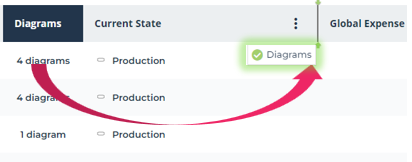
Resetting the column order
If you have modified the column order, you can return to the default order.
See also: Resetting column configuration.See also: Resetting your Desktop Customizations.To reset the column order:
1. In your HOPEX desktop, access the list of objects.
2. Hover the cursor over the column header and click More .
.3. Select Reset column order.
The columns display in their default order.
Resetting column configuration
In a list, every customization at the column level is saved, even after signing out.
You can reset all the customizations that you have performed on columns, that is:
• displaying/hiding columns
• column width
• column order
• column locking
To reset the column configuration:
1. In your HOPEX desktop, access the list of objects.
2. Hover the cursor over the column header and click More .
.3. Select Reset column configuration.
Filtering a list data
In an object list you can quickly filter data of one or several columns.
You can, for example, filter the objects of a list to display only the objects whose specific characteristic contains a string of characters with a specific character.
Operators available on a character string:
•  : to show values including the character string
: to show values including the character string•  : to show values that do not include the character string
: to show values that do not include the character string•  : to show empty values only
: to show empty values only•  : to show non empty values only
: to show non empty values onlyOperators available on a number or a date:
•  : to show values equal to
: to show values equal to•  : to show values greater than
: to show values greater than•  : to show values lower than
: to show values lower than•  : to show values between two values
: to show values between two values• : to show empty values only
: to show empty values only• : to show non empty values only
: to show non empty values onlyTo define a filter on a column:
1. In your HOPEX desktop, access the list of objects.
2. Click Display filters  on the top right-hand side.
on the top right-hand side.Fields appear under the header of each column.
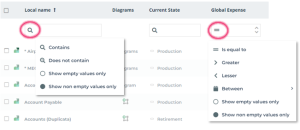
A default operator is displayed in the filtering field of each column.
3. (if needed) In the field of the column that you want to filter, click the operator and select another operator.
4. In the field of the column that you want to filter, depending on the case:
• enter a string of characters.
• select one of the proposed values.
• enter a number.
The list of objects is automatically filtered according to the filtering criterion defined for the column.
The title of the column that contains a filtering criterion is highlighted.
You can add as many filters as columns.For example, to the list of applications, you can filter applications whose:
- the corresponding expenses are above 3000€
- the Obsolescence Risk is “Very high”
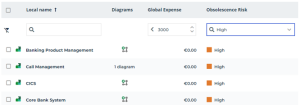 To remove the filter from a column, hover the cursor over the filter field and click
  .To remove the filtering from all columns, at the end of the filtering field row, click Delete All Filters
  .
.Grouping data by field
In an object list, you can group the objects that have an identical attribute value.
To group objects:
1. In your HOPEX desktop, access the list of objects.
2. Hover the cursor over the column header and click More .
.3. Select Group by this field.
The objects are ranked according to the chosen value.
In the More menu of all columns, Display in groups is selected.
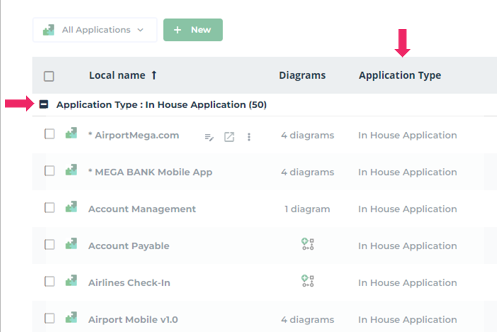
menu of all columns, Display in groups is selected.To disable presentation in group mode, in a column, clear Display in groups.In the list of applications, you can for example group applications by type.
Freezing a column
In a list, by default, the columns are presented in the following order:
• check box
• icon of the object type of the list
• Local Name
Freezing a column anchors it at one place, irrespective of the scrolling bar. The column scrolling cursor is positioned at the level of the first unfrozen column (by default after Local Name).
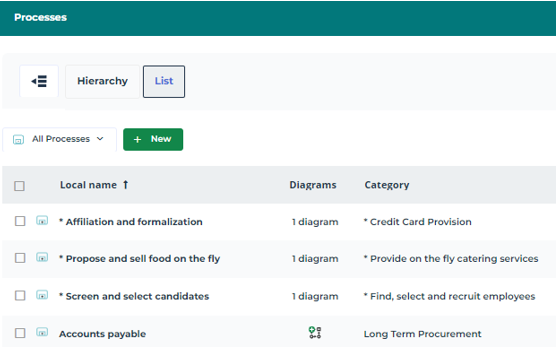
If necessary, you can position one or more columns directly to the right of the Local Name column. To do this, you must freeze the column.
To freeze a column:
1. In your HOPEX desktop, access the list of objects.
2. Hover the cursor over the column header and click More .
.3. Click Freeze Pane.
The column is moved to the right of the Local Name (or to the right of the last column already frozen)
The scrolling cursor is positioned after this column.
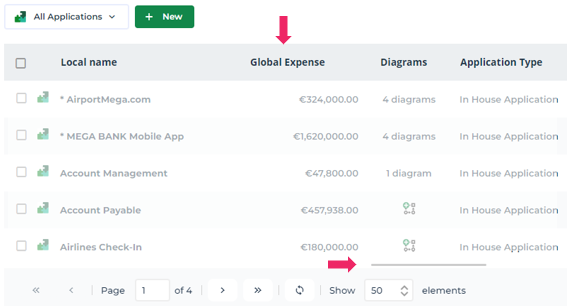
To disable freezing of a column, select Unfreeze or move the column.You can, for example, place the Technology Compliance column directly after Local Name so it remains displayed when you view the other columns. The column scrolling cursor is positioned at the first unfrozen column level (after Global Expense).
Mass modification of the data in a list
HOPEX can be used to assign the same attribute value to several objects in a list.
Tags can not be managed in mass at the list level, see Mass Addition of a Tag to Objects.To assign the same attribute value to several objects:
1. In your HOPEX desktop, access the list of objects.
2. In the list, select the objects concerned.
3. In the column of the attribute concerned, specify the new value in one of the fields of the selected objects.
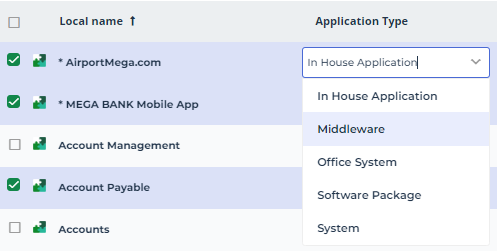
The new value of the field is assigned to all selected objects.