Parameterizing the Export File
Once you have chosen your export template type, the export wizard opens to a workbook parameterization window. When using a (predefined or user) template, you may use it as per or carry out modifications in this parameterization window.
You can:
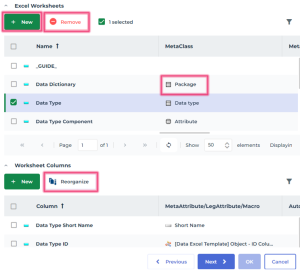
• add or remove worksheets
• add or remove columns
• reorganize the columns
• modify the data concerning worksheets and columns
 Once done with the parameterization, see Selecting Objects to Export.
Creating a worksheet
To create a worksheet (for example “Application”):
1. In the Excel Worksheet pane of the Excel export wizard, click New  .
.
.A new worksheet appears in the list.
2. Modify the name of the worksheet if necessary.
3. Indicate the type of data associated to the sheet (for example “Application”).
See Worksheet data types. Configuring a new Excel export file
An Excel sheet can be of two types:
• MetaClass (objects list + characteristics)
• MetaAssociationEnd (links + link characteristics)
In the following example, the file contains three worksheets:
• the first worksheet contains applications
• the second worksheet contains links of "Defined Service" type between applications and services
• the third worksheet contains application services
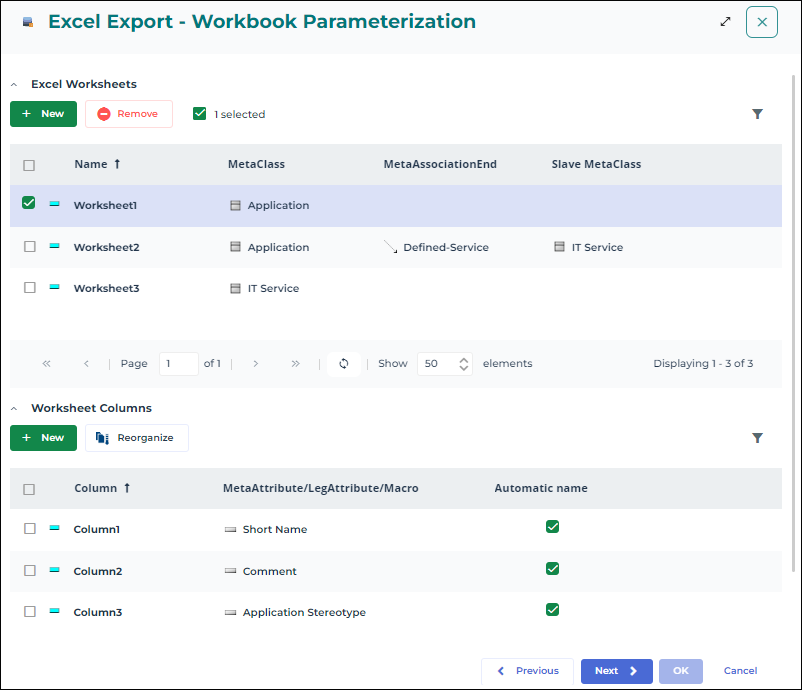 If you select a worksheet, the list of imported fields appears in the Worksheet Columns section. For each application, the name, code, comment and type are displayed.
At this stage, you may click Finish. You obtain an export template that you can fill out later on.
Creating worksheet columns
Columns of an Excel worksheet specify attributes of the object selected in the Excel worksheet.
To create a column:
1. Select the Excel worksheet for which you wish to create a column.
2. In the Worksheet Columns area, click New.
3. The column appears in the list.
4. (If needed) Modify its name.
5. To indicate the attribute to be displayed in the column, click in the MetaAttribute/LegAttribute/Macro column and select List MetaAttribute/LegAttribute/Macro.
A dialog box lists MetaAttributes, LegAttributes and Macros available on the object type specified in the Excel worksheet. If the worksheet object type is a link, the dialog box lists the link attributes.
For more details on macros, see Using Macros in Excel Import/Export Files.6. Select a MetaAttribute.
7. Click OK.
Worksheet data types
In a worksheet you can define:
• a MetaClass
• a link type
To specify one MetaClass (e.g.: Application):
1. Select the worksheet of interest in the list.
2. Click in the MetaClass column, click the arrow and select List MetaClasses.
The query dialog box appears.
3. Select the MetaClass of your choice.
4. Click OK.
E.g.: “Application”.
To specify a link type:
1. Select the worksheet in question.
2. In the MetaClass column, select the master MetaClass.
Ex. "Application".
3. In the MetaAssociationEnd column, select the MetaAssociationEnd.
Example: "Service defined".
4. In the Slave MetaClass column, select the slave MetaClass.
Example: “IT service”
When the link sends to a concrete MetaClass, the column of the slave MetaClass is completed automatically. When it sends to an abstract MetaClass, the list of concrete MetaClasses is proposed.Automatic name
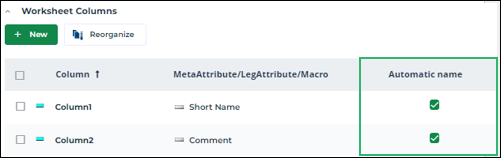
When selected, the Automatic Name check box indicates that the file column takes the name of the MetaAttribute (for example "Short name"). If you clear this, the column takes the name indicated under Column ("Column 1").