"Logical to Physical" Synchronization Rules
The following rules are applied for transforming class diagrams into relational formalism.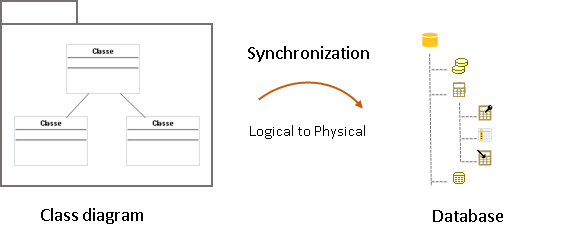
Logical to Physical Synchronization: the Entities (or Classes)
In Logical to Physical mode, classes and entities are processed in the same way by the synchronization tool.
 By default, the synchronization tool applies the class diagram logical formalism. See Logical Formalism and Synchronization.
General rule
• Any non-abstract entity of the model becomes a table.
• The entity identifier becomes the primary key for the table. If the identifier is implicit, a column is automatically created. See Configuring Name Generation.
• Entity attributes become columns in the table.
• Mapping rules are applied to determine the column datatypes from the datatype (DM) of each attribute. The possible configurations depend on the DBMS.
 For more detailed information, see Data Types and Column Datatypes.
Sub-entity
• The foreign key reflecting dependency between the sub-entity and its super-entity is created.
Abstract entity
An abstract entity does not produce a table at synchronization.
If constraint associations point to an abstract entity, the corresponding foreign keys are not created, but columns corresponding to the foreign keys are created to respect table integrity.
When a sub-entity is abstract, all columns and foreign keys of the corresponding table are taken by the table corresponding to the super-entity.
Conversely, when a super-entity is abstract, all columns and foreign keys of the corresponding table are taken by the table corresponding to the sub-entity.
To define an abstract entity:
1. Open the properties dialog box of the entity.
2. Click the Characteristics tab.
3. In the Abstract box, select "Yes".
Realized entity
An entity is said to be realized if it produces creation of a table at synchronization.
A "not realized" entity is treated as an abstract entity.
Unlike the "abstract" property which characterizes the entity in all use cases, the "realized" concept applies only in the context of database synchronization. See Realized mode.