Logical to Physical Synchronization: the Parts (UML)
Synchronization of parts is available by default with the new UML formalism. See Logical Data Modeling Options.
The result of the synchronization is determined by the combination of the Whole/Part link (None, Aggregation, Composition) and the Multiplicity defined on the part.
For more information on parts, see The Parts.
|
Multiplicity
|
Whole/Part link
|
|
|---|---|---|
|
Aggregation
 Composition
 |
None
|
|
|
None (*)
2 / 6 1..* |
The part gives rise to a foreign key to the owner class 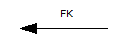 |
The part gives rise to a table between the two classes 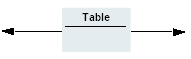 |
|
1
0 / 1
|
The part gives rise to a foreign key to the referenced class 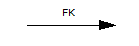 and gives rise to a foreign key to the owner class |
The part gives rise to a foreign key to the referenced class |
Example 1: None / *
In the following example, the “Person” class references the “Car” class, without multiplicity constraint.
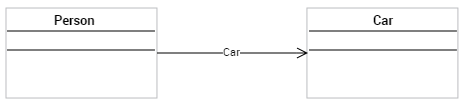
After synchronization, the “Car” part gives rise to a table:
• A column is created for each attribute of connected entities identifiers.
• The primary key for the table uses all these columns.
• A foreign key is also built for each connected entity.
Example 2: Aggregation / *
A car can have one or several wheels.
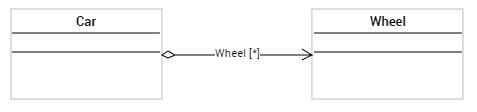
After synchronization, the part gives rise to a foreign key to the “Car” class.
Example 3: Composition / 0..1
An order contains an invoice.
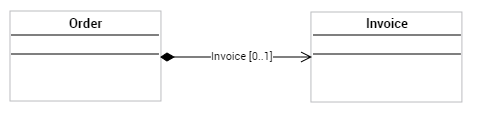
After synchronization:
• A foreign key references the “Invoice” table in the “Order” table.
• A foreign key references the “Order” table in the “Invoice” table.