Building the Logical Architecture
HOPEX IT Architecture provides ways to define logical application architectures that represent ideal architectures. These representations make it possible to design logical structures for application architectures, to rationalize exchanges between these structures and to identify the data used. Logical application architectures can then be compared with the implemented architectures to detect gaps between the real and the ideal.
 For more details on use of a logical application system, see Describing Logical Application Architecture.
Logical application systems can be described using a top-down approach, starting with a description of the company's main application systems, or a unitary approach, describing only some logical application systems.
 A logical application system is an assembly of other application architectures, logical applications and end users, interacting with application components to implement one or several functions.
If you use a unitary approach, you must describe the Application Logical System Environement to provide a context to the use of the logical system and its service interactions with exeternal, logical components.
A logical application system environment presents a logical application system use context. It describes the service interactions between the logical application system and its external partners, which allows it to fulfill its mission and ensure the expected functionalities.At this level of the method, this step, which is not mandatory, covers the following points:
• Identify the exchanges between the logical components and formalize them through service interfaces.
A Service Interface is a template of a contract between entities (organizational, IT …). The contract is described by available operations which can be triggered trough messages exchanged by roles (vendor, buyer..).For further details about service interfaces, see Describing information exchanges.• Verify that the logical architecture covers the functional requirements identified in the business capability maps.
Structure diagram of the logical application system
The logical application system components are described in a diagram featuring:
• the services offered or required;
• the processes handled, the components and their interactions service;
• the end users interacting with the application components.
The following diagram describes the structure of the logical application system "Purchase request processing" offered to customers.

“ Purchase Request Processing” Logical application system structure diagram
“Internet Purchase Requests" are offered to customers either directly or through a "Call Center".
Requests made by customers are processed by a "Internet Purchase Requests" logical application system.
The logical application system structure diagram, for managing “Purchasing Requests”, presents different logical applications, access to a logical database as well as service and request points for “Internal request service" or "Order".
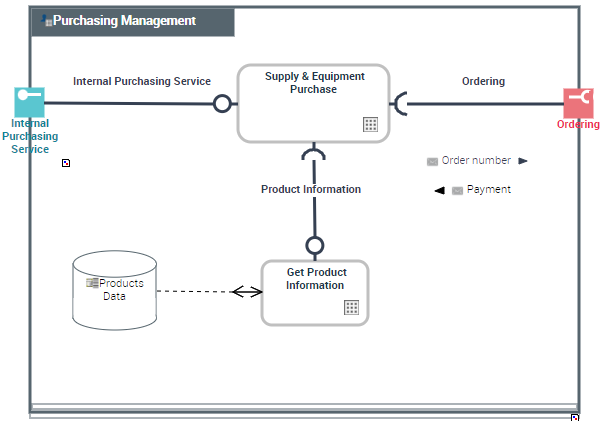
“ Purchasing request Management” Logical application system structure diagram
For more details on use of a logical application system, see Describing a Logical Application System with HOPEX IT Architecture.Logical application system environment diagram
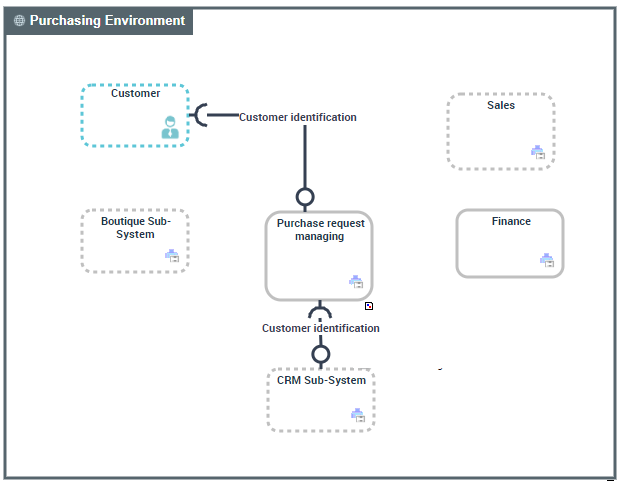
A logical application system environment presents a logical application system use context. It describes the service interactions between the logical application system and its external partners, which allows it to fulfill its mission and ensure the expected functionalities.The components of a logical application system environment are presented in an application system environment diagram that describes the internal logical application systems as well as the partner logical application systems.
 s
sLogical application system environment diagram
Purchasing requests are formulated by users in conditions specified by Sales service and also the Finance service which are external to the described environment.
For more details on use of a logical application environment system, see Logical Application System Environment Description.