Defining the transformation strategy
After having described the current state and analyzed the suitability between the business capabilities of the enterprise and value architecture elements, this step consists in drawing up the list of needs for change (or driver) identified at the various levels by the stakeholders (or interested parties), and assessing them in order to establish the list of enterprise goals.
 A goal tends to be longer term, and defined qualitatively rather than quantitatively. It should be narrow-focused enough that goals can be defined for it.
Defining the enterprise and its evolution in time
An enterprise is described by the following elements:
• a business capability map,
• value streams,
• goals and strategies of the transformation,
• Transformation stages which define the concrete implementation of the transformation.
A Business Transformation Stage is a kind of Enterprise Transformation Stage aiming at the alignment of the enterprise business operating model to its business strategy and corresponding exhibited business capabilities (business model). For more details, see Creating an enterprise.
Identifying transformation strategic elements
This step consists of identifying the strategic elements that meets the transformation drivers.
For more details, see Defining enterprise strategic elements.An enterprise diagram is used to describe the links between the strategic elements (Goals, strategies, tactics and transformation stages).
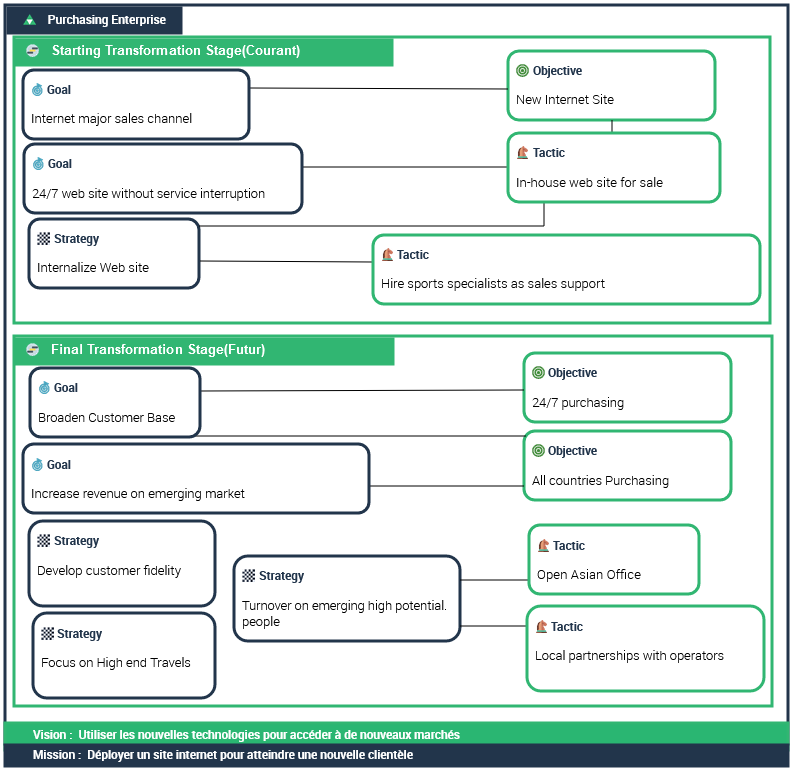 For more information on this diagram, see Building an Enterprise Diagram.
Assessing business capabilities and their implementation
.A business capability is a set of features that can be made available by a system (an enterprise or an automated system).From an enterprise stage, it is possible to assess the business capabilities of the business capability map connected to the enterprise.
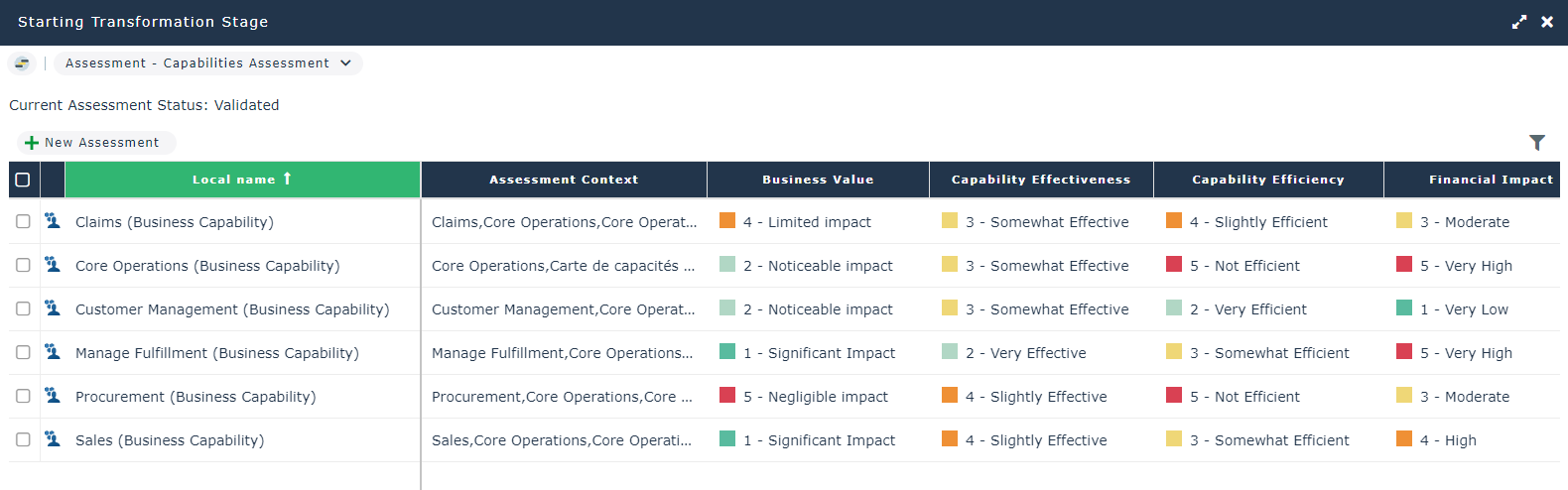 For more details on assessing capability maps, see Using assessment for business capabilities and their implementation.
Identifying exhibited business capabilities
A Business Capability that is exhibited by an Enterprise Stage with quantified measure (KPI) and potential geopolitical scope (Site) for a defined market segment (Business Partner).From a transformation stage, it is possible to create exhibited business capabilities that can connect the transformation strategic elements to the technical or organizational elements that assure their implementation.
For more details on exhibited business capabilities creation, see Managing exhibited business capabilities.The exhibited business capabilities are assessed with respect to different criteria or dimensions (KPI dimension).
For example, the competitiveness of a delivery capability is measured according to a 'delivery time at target cost'.
These dimensions give rise, for a given transformation stage, to key performance indicators or KPIs.
For example, a delivery capability can have a target of 'delivery time in less than 48 hours for a cost price less than 10% of the sales price' within the framework of a given transformation stage.
A composite KPI defines the grouping of elementary KPIs that should be examined together in order to appreciate the performance of an item with KPI. E.g.: a delivery must take place in less than 20 minutes and cost less than 5 euros.For more details on KPIs, see Using KPIs.