Describing an Enterprise Architecture (EA) Project
EA Project Characteristics
To specify the characteristics of an EA project:
2. In the properties dialog box, select the Characteristics tab/page.
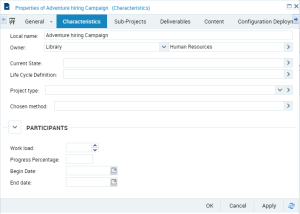
3. In the Characteristics tab you can modify the Name of the project and define:
• the project type to which the project corresponds.
 An EA project type defines project typology such as description of a business process, mapping or development of applications, etc. A project type can be implemented using one or several methods.
 For more details on project types and methods, see EA Project Creation Wizard.
• The Workload necessary for execution of the project and its Progress Percentage.
• Project start and end dates.
EA Project Content
In the EA project properties dialog box, from the Content tab/page, you must declare all objects that will be impacted by the EA project. These are objects that will be presented to the different project participants as the project progresses.
EA Project Participants
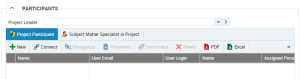
In the EA project properties dialog box, you can specify information concerning project participants.
Participants are the project head, modeling participants and business specialists, who will validate modeled objects (such as capabilities or processes).
To specify main participants of the EA project:
 In the properties page of the project, select the Characteristics tab/page and expand the Participants section.
There are three types of participant:
• The Project Head, who is responsible for the project and executes the following tasks:
• Identifies the different project org-units: project participants, owners, business specialists.
• Assignment of participants in project steps.
• The project head is responsible.
• Project status management.
• Evolution project creation.
• The Project Participant is a generic role enabling assignment of a user to a project.
• The Business Specialist assigned to the project is the main user of the solution. Intervenes on the process architecture at each project phase.
EA Project Objectives and Requirements
Project objectives are specific to a project, for example: "Project duration must not exceed six months" or "Project must implement an Agile method".
An objective is a goal that a company or organization wants to achieve, or is the target set by a process or an operation. An objective allows you to highlight the features in a process or operation that require improvement.For more details on the use of project objectives and requirements, see report Objectives and Requirements.Project requirements are the constraints imposed, for example: "Project must be executed using new version of Visual Studio" or "Project must be executed without intervention of external company".
A requirement is a need or expectation explicitly expressed, imposed as a constraint to be met within the context of a project. This project can be a certification project or an organizational project or an information system project.The objectives and requirements assigned to a project should be distinguished from objectives and requirements assigned to capabilities, processes and applications handled by the project (which appear in the project Content tab).
To specify objectives and requirements assigned to an EA project:
2. Ensure that the Objectives and requirements modeling option is selected.
You can access this via: Main menu > Settings > Options > HOPEX Solutions > Common Features.3. In the project properties dialog box, select the Objectives and Requirements > Objectives and Requirements tab/page
4. Specify the links Assigned Objective and Imposed Requirement.
Main menu > Settings > Options > HOPEX Solutions > Common Features.For more details on the use of project indicators, see report Objectives, Indicators and Requirements.