Accessing your IT architectures elements with HOPEX Digital Transformation Desktop
To access your enterprise architecture objects:
1. Click the navigation menu, then Application Architecture.
2. In the navigation pane, click Inventory.
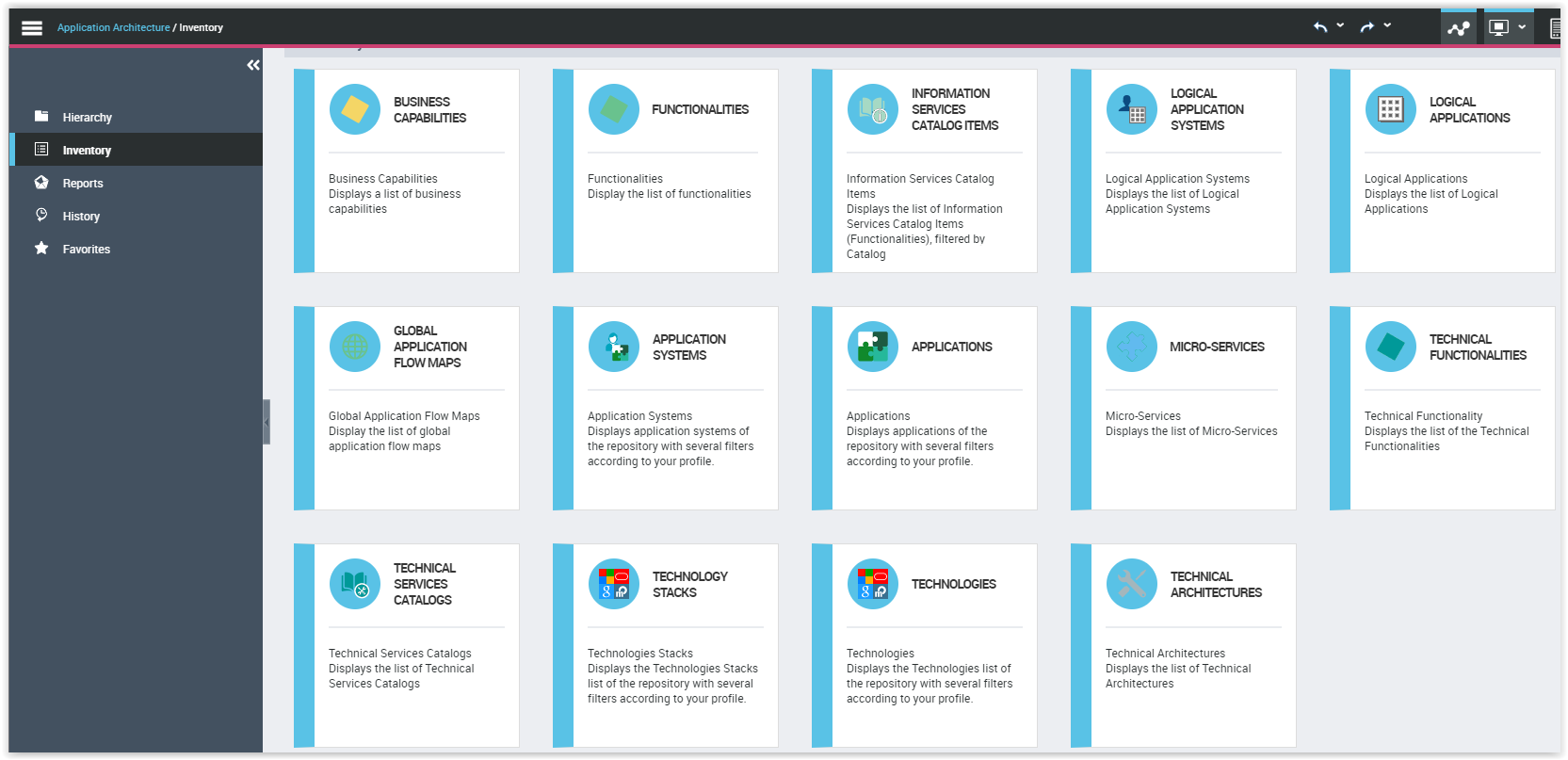
A list of tiles is proposed to help you to manage your IT Architecture elements:
• Business Capabilities and Functionalities enable you to manage IT transformation projects with the HOPEX IT Strategy option.
 .A business capability is a set of features that can be made available by a system (an enterprise or an automated system).A functionality is a service required by an org-unit in order to perform its work. This functionality is generally necessary within an activity in order to execute a specific operation. If it is a software functionality, it can be provided by an application.
 See "Managing IT transformation", page 95 in the HOPEX IT Architecture guide.
• Logical Applications and Logical Application systems enable you to manage your logical architecture elements.
A logical application is a set of application functionalities that is independent of a particular implementation. For example, the classification of all purchase request processing applications implemented in an enterprise.A logical application system is an assembly of other application architectures, logical applications and end users, interacting with application components to implement one or several functions.See Modeling Business Capabilities and the logical application architecture in the HOPEX IT Architecture guide.• Applications;
An application is a software component that can be deployed and provides users with a set of functionalities.• Application Systems;
An application system is an assembly of other application systems, applications and end users interacting with application components to implement one or several functions.• Micro-services;
A micro-service is a software component that can be deployed autonomously, but which does not directly provide an end user service. It can interact with other application services, applications or application systems. This is a deployable software component that uses software technologies. For example: an authentication service, a PDF file printing service.See "Describing an IT Service with HOPEX IT Architecture", page 95 and "Describing a Micro-Service with HOPEX IT Architecture", page 97 in the HOPEX IT Architecture guide.• Technologies;
A technology is a definition or format that has been approved by a standards organization, or is accepted as a standard by the industry.• Technical Architectures;
A technical architecture is a set of interacting techniques that, together, deliver one or more application components.• Technical Service Catalogs and Technical Service Catalogs Items describe the list of functionalities covered by a service as well as the technical or functional elements that implement these functionalities.