Logical Data Structure
In HOPEX Information Architecture, access to logical data in the repository is reserved for the Data architect.
Base elements
Data dictionary
A data dictionary collects and holds a set of logical data, and provides them with a namespace.
The data dictionary therefore participates in the organization of data in the HOPEX repository.
Package
A data dictionary is implemented by the concept of Package. The package allows you to classify data such as classes, data areas, data maps, etc. You can create sub-packages.
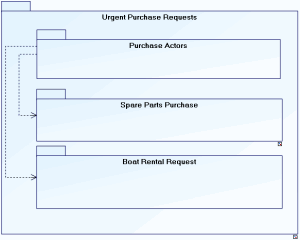
Urgent purchase requests are provided to process purchase of spare parts and boat rental requests. In both of these cases, users are actors of the purchasing domain.
 For more details on the use of packages, see the HOPEX Application Design guide.
Class diagrams are used to graphically represent the elements of a package.
See The Class Diagram.
Data model
When you choose to work with the "Datamodel" formalism, business dictionaries are represented by data models (not packages).
For more details on creating and updating a data model, see "The data model", page 29.
Example
The data model of the "Purchase Request Automation" project is presented below.
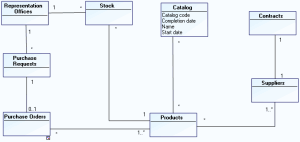
The application manages purchase requests, orders and product stock levels in each of the representation offices.
A centralized catalog of products and suppliers is installed.
Contracts with referenced suppliers are also accessible from the application.
Logical Data Map
A logical data map represents the data areas of a data dictionary and their dependency links.
Data area
A data area represents a restricted data structure dedicated to the description of a software Data Store. It is made of classes and/or data views and can be described in a Data Area Diagram.
For more details, see Logical and application data areas.
To address these specific use cases, you can create Data Views in which you can see and modify the scope covered by the classes.
Logical data view
From the perimeter of an object in a data dictionary or a data area, a logical data view allows you to define a set of information for a specific use. See Logical Data Views.