Process Steps Sequence Flow
Tasks
In a BPMN process, tasks are associated with processing steps requiring the intervention of an enterprise participant (for example an organization org-unit or an IT service).
A task can be industrial (machining a component), logistical (receiving a delivery), or it can involve information processing (entering an order).
At simulation, the participants execute the process tasks. These tasks may also require use of application services or other resources.
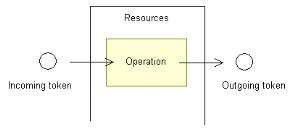
Execution of a task is generally triggered by the fact that a token takes the sequence flow that connects the task to other objects describing process organization.
However, a task can also be triggered by merging several tokens from either a gateway, or from several sequence flows.
Events
BPMN events enable representation of:
• The simulated process start point: this is the point from which tokens are generated. Nature of these events must be Start or Catching,
• The point marking the end of the simulated process: the tokens then exit the system. Nature of these events must be End or Throwing,
• Occurrence of a particular fact that modifies behavior of the current process or another process. Events used in this case are of intermediate nature Catching or Throwing.
See also: Event Advanced Characteristics.
Managing task inputs
Several sequence flows can lead to the same task. In this case, we must define token processing policy at task input.
By default, each token arriving in a task is taken into account as soon as the resources required for its processing are available. Input policy is then exclusive type, or Junction.
If input policy is parallel type, or Synchronization, a token must arrive via each of the different sequence flows to be grouped into a single token which will execute the task.
For example, in an order delivery process, the various items that make up the order are processed separately. These items are then assembled to form a single order.

Managing task outputs
A task can produce different processings executed in parallel. There are basically two output policies:
• A policy of exclusive type, or Condition: the incoming token is directed onto one and only one sequence flow of the different possible outputs.
 By default, the output policy of a task is Parallel type, except if an output link is explicitly specified as Condition type.
• A policy of Parallel type, the token is duplicated and directed onto each of the output sequence flows.
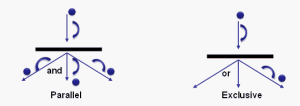 Although the BPMN standard covers other input and output management policies, only the Parallel and Exclusive policies are taken into account by the simulator.
See also:
