Event Advanced Characteristics
HOPEXproposes all events introduced in the BPMN standard. For more details on how to use these in a process diagram, see “", page 52.
The HOPEX simulator allows you to associate a duration and a cost to an event, whatever its type or nature.
In standard mode, you can also attach a data collector so as to view results specific to the event. See Data collector.
Connecting processes by events
To be able to execute simulation on several sequenced processes, it is important to correctly connect events to sequence flows. For more details on specification of these links, see “Connecting Events to Sequence Flows", page 40.
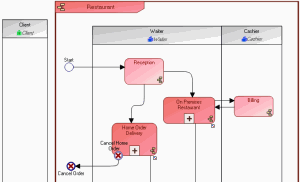
In the "On Premises Restaurant" example, we must distinguish between tokens arriving at the "Reception" operation representing the arrival of new clients, from the "Billing" operation that represents issue of a new bill. In addition, at output we must distinguish between tokens representing the end of the meal from tokens representing issue of the order to the cashier.
 Events taken into account at simulation of a process as well as errors encountered are indicated in the service report. See Updating a Scenario.
Processing an event attached to a process
An event placed at the edge of a process is considered by the simulator as an output of the process handled in a specific way. For more details on how to attach an event to a process, see “Attaching an Event to a Process", page 42.
From the viewpoint of the simulator, an event placed at the edge of a process can be processed in various ways:
• If the process is not described, the probability of occurrence of the event placed at the edge of the process is defined on the event output sequence flow .
Implicitly, the simulator firstly considers an exclusive choice between the edge event and all other process outputs.An error is generated if no probability is specified on the edge event output sequence flow.• If the process is described and the edge event is connected to an internal event within the process, then each token arriving at the process internal event is sent to the edge event.
• If the process is described but no internal event is connected to the edge event, the description of the process is ignored, and the simulator takes into account the probability of occurrence of the event as specified on its output sequence flow.
It is also possible to exclude from the scenario the event attached to the edge of a process.