HOPEX NAF (EN) : The HOPEX Metamodel for NAF
   
The HOPEX Metamodel for NAF
 
Notation
Notation
Examples
All Views Metamodels
NAV-1 Overview and Summary Information
NAV-2 Integrated Dictionary
NAV-3a Architecture Compliance Statement (Metadata)
NAV-3b Metadata (extensions)
Capability Views Metamodels
NCV-1 Capability Vision
NCV-2 Capability Taxonomy
NCV-3 Capability Phasing
NCV-4 Capability Dependencies
NCV-6 Capability of Operational Activities Mapping
NCV-7 Capability to Services Mapping
Operational Views Metamodels
NOV-1 High-Level Operational Concept Description
NOV-2 Operational Node Connectivity Description
NOV-3 Operational Information Requirements
NOV-4 Organizational Relationships Chart
NOV-5 Operational Activity Model
NOV-6a Operational Rule Model
NOV-6b Operational State Transition Description
NOV-6c Operational Event Trace Description
NOV-7 Information Model
Service-Oriented Views Metamodels
NSOV-1 Service Taxonomy
NSOV-2 Service Definitions
NSOV-3 Services to Operational Activities Mapping
NSOV-4 Service Orchestration
System Views Metamodels
NSV-1 System Interface Description
NSV-2a System Port Specification
NSV2b System Port Connectivity
NSV-2c System Connectivity Clusters
NSV-2d System Communication Quality Requirements
NSV-3 Resource Interaction Matrix
NSV-4 System Functionality Description
NSV-5 System Function to Operational Activity Traceability Matrix
NSV-7 System Quality Requirements Description
NSV-8 Systems Configuration Management
NSV-9 Technology Forecast
NSV-10a Systems Rule Model
NSV-10b Resources State Transition Description
NSV-10c Resources Event-Trace Description
NSV-11a Logical Data Model
NSV-11b Physical Data Model
NSV-12 Service Provision
Technical Views Metamodels
NTV-1 Standards Profile
NTV-2 Standards Forecast
NTV-3 Standards Configuration
Programme Views Metamodels
NPV-1 Programme Portfolio Relationships
NPV-2 Programme to Capability Mapping
This chapter presents all the HOPEX metamodels used to implement the NAF views.
A graphical representation of each metamodel is included, each with HOPEX names. If the names are changed when the NAF Metamodel Customizations add-on is imported, the new names are highlighted in yellow near the HOPEX names.
*Some views are not directly supported by a dedicated metamodel. They are instead linked to data modeled in two or several other views.
Notation
The metamodel diagrams in this section are based on the UML notation. Below are a few points to help you better understand these diagrams.
 
Concept
Meaning
Notation
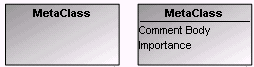
MetaClass
Defines object type.
Each rectangle may include a list of properties.
 
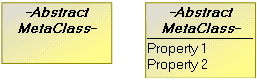
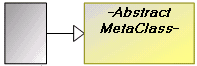
Abstract MetaClass
This concept cannot be instantiated and must be inherited from concrete metaclasses (gray rectangle).
Each rectangle may include a list of properties.
 
Association
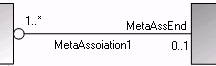
For each association :
- Association end names are displayed to indicate the relationship between the linked objects.
- The multiplicity (1, 0..1, *) is displayed for some associations. This determines the range of linkable objects.
- A white circle at the end of an association indicates which is the major object in the association, i.e., the object which is modified in case the association is removed.
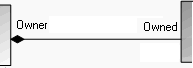
- A black diamond at the end of an association indicates that the other object is a component of the major object. It is a strong association between the two objects. When the major object is deleted, all is components are also deleted.
 
 
Inheritance
Inheritances are illustrated by arrows drawn between concepts.
 
 
Examples
Where appropriate diagrams exist in, metamodels are illustrated by examples. These examples are used to illustrate how notions and relationships are drawn in specific diagrams. The content is therefore not at all concrete; the names of items are based on the names of notion suffixed by a random number so that the reader is able to associate the graphical representation to their corresponding object types.