NOV-4 Organizational Relationships Chart
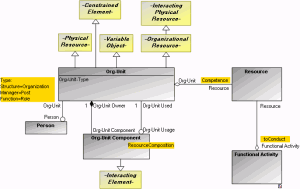
Organizational units are modeled thanks to the Org-Unit metaclass. In the NAF metamodel implementation, org-units are composed via a whole-part model that means there are contextual intermediate items at each hierarchy level to bring the contextual dependencies (in this case information interactions).
Three types of org-units can be used: Organization, Post and Role. These are types usually delivered by HOPEX with other names but these names appear if the NAF Metamodel Customization add-on has been imported.
Organizational-units inherit from several abstract notions that support the following features:
• Variable Object: enables the creation of variant of the organization-units. Each variant inherits from the components that can be replaced or excluded.
• Constrained Element: enables the adding of constraint to the organizational units. Constraints are defined in the
• Physical Resource: enables the connection of process performance items and interaction scenario performance items. These items are the links between the organizational structure and the processes or interaction scenarios that describe the behavior of the structure.
• Organizational Resource: enables the ownership of interactions and communication channels between the components of an organizational unit.
An organizational unit can also be connected to some resources that define the competencies he can develop.
Finally, organizational units are embodied by persons that have the role defined in the organizational structure.
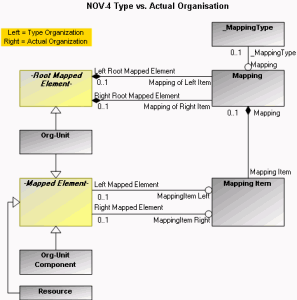
The NOV-4 metamodel also introduces the notion of a mapping between organizations defined at a type level and those defined as the actual organizations. These mapping allows for example to associate generic definitions to concrete organizations deployed in different geographical sites.
The following figure shows the metamodel that supports this mapping. A Mapping Type defines the mappings that can be created. In this situation the mapping is between root organizational units. A notion of left and right mapped element is introduced that is a generic term to differentiate between both set of mapped items. Indeed, the mapping relationship is considered as an equivalence association and there are no preferred directions.
The Organizational Structure
Once a mapping is created, the sub items can be mapped. There are connected thanks to Mapping Items. In this mapping, the org-unit components and the resources (competences) can be mapped.