Building capability maps and business function architectures
The goal of this step, on a strategic level, is to check the suitability between the business capabilities of the enterprise, the business functions delivering this capabilities as well as the required functionalities or business skills.
This consists of the following tasks:
Describing the existing architecture of business capabilities
Building the business capability map
A business capability map describes what the enterprise is capable of producing for its internal needs or for meeting the needs of its clients.

A business capability map is a set of business capabilities with their dependencies that, together, define a framework for an enterprise stage.
.A business capability is a set of features that can be made available by a system (an enterprise or an automated system).
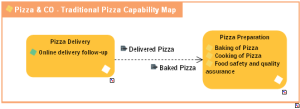
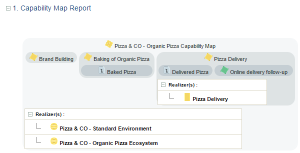
The capability map thus presents the business capabilities of the highest level for one of the stages of the enterprise plan.
In this example, the business capability to deliver pizzas is based on the business capability to cook them.
Defining the performance indicators for business capabilities
The main business capabilities are assessed with respect to different criteria represented or dimensions (KPI dimension).
For example, the competitiveness of a delivery capability is measured according to a 'delivery time at target cost'.
These dimensions give rise, for a given enterprise stage, to key performance indicators or KPIs.
For example, a delivery capability can have a target of 'delivery time in less than 25 minutes for a cost price less than 10% of the sales price' within the framework of a given enterprise stage.
A composite KPI defines the grouping of elementary KPIs that should be examined together in order to appreciate the performance of an item with KPI. Eg: a delivery must take place in less than 20 minutes and cost less than 5 euros.
Describing the business capability breakdown
Business capabilities are then described more precisely to identify:
• a more detailed granularity capability breakdown;
• the expected effects of the capability;
• the business skills or functionalities required for each of them;
• the dependencies between capabilities (expected effect of one dependent from the result of the other).
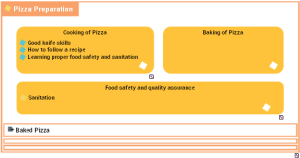
For example, the business capability that consists of preparing pizzas is broken down into a number of business capabilities: "cook the pizzas", "Use the oven".
HOPEX Business Architecture provides a report available detailing the breakdown of capabilities.
Defining the business skills and functionalities associated with business capabilities
To be able to then check that each business capability is correctly implemented by suitable solution building block, you must define the required business skills and functionalities.
For example, the "Cook pizzas" business capability requires skills to "Make pizza dough".
A functionality is a capability expected from an equipment item (hardware or software) to ensure the operation of a business function or an organization.
Describing Business function architecture elements
Describing a business architecture environment
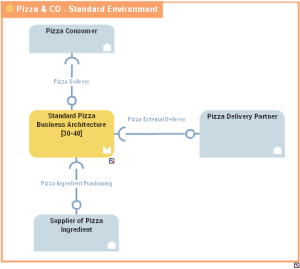
A business architecture environment represents the relationships of a business function architecture with its partners.
In this example, the business function architecture environment of the pizza-making company is made up of the historical business function architecture and its interactions with external partners: clients and suppliers. You can see in the diagram that delivery is outsourced to a third party deliver partner.
A business function architecture is a set of interacting business functions that, together, delivery one of more business capabilities.
A business partner designates a third-party who is in relation with the enterprise within the framework of a given business architecture environment. Examples: private sector client, regulatory organization, supplier.
Communications between the objects are represented by interactions.
An interaction represents a contract established in a specific context between autonomous entities that are internal or external to an enterprise. These entities can be org-units, applications, activities or processes, or external org-units. The content of this contract is described by an exchange contract.
Describing a business function architecture
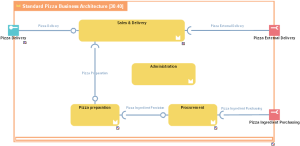
A business function architecture is a set of interacting business functions that, together, delivery one of more business capabilities.
In this example, the "Pizza making" history business function architecture is based on the business function architectures for selling, delivering and preparing pizza business function architectures.
Defining the business skills and functionalities associated with business functions
To be able to subsequently check that each business capability is implemented by a suitable business function, you must define the required business skills and functionalities, for each business function.
A functionality is a capability expected from an equipment item (hardware or software) to ensure the operation of a business function or an organization.
Describing functional processes
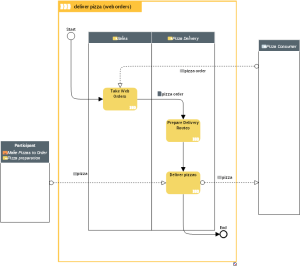
A given business function architecture runs one or more processes to provide the services expected within the framework of its interactions with other business functions or business partners.
A functional process is represented by a sequencing of activities managed by the business functions of the architecture.
A functional process is a value chain providing results as goods or services, to an internal or external client of the enterprise or organization. This value chain is described as a sequence of activities.
Describing business capability implementation by the business functions
This involves connecting the business capability, which corresponds to what we know how to do or what we want to do and which materializes the purpose, to a realizing business function or business function architecture, defining the mean to implement the capability at a conceptual level, that is, upstream of organizational and technical choices.
A business function architecture is a set of interacting business functions that, together, delivery one of more business capabilities.
This business function architecture will itself carry the functional processes whose activities will require its business function components.
Construction of the business capability map on the one hand and the business architecture environment on the other hand is used to check that the business capabilities are implemented by the business functions.
HOPEX Business Architecture provides a report that presents the result of the implementation of business capabilities by business functions.

Example of business architecture breakdown report.