Adding Physical Properties to Database Objects
When your database has been defined in a relational diagram, you can generate the corresponding SQL scripts for the different DBMSs.
The physical data navigation pane allows you to complete database physical modeling by specifying parameters specific to each DBMS and therefore to produce complete SQL scripts.
In Hopex, you can also import physical parameters defined on reverse engineered objects. See: Physical Properties Reverse Engineering.
You can adapt the same logical model to several DBMSs. It is not necessary to duplicate objects.
Target DBMSs
To define a target DBMS on a database:
1. Open the properties dialog box of the database concerned.
2. Click the Characteristics page.
3. Specify the target DBMS field in the corresponding field.
See also Importing a DBMS Version.
Creating Physical Properties
To create physical properties on objects of a database:
1. On the desktop, click the navigation menu then Data Architecture > Physical data.
2. In the edit area click Database physical hierarchy.
The list of repository databases appears in the edit area.
3. Expand the folder and the sub-folders of the databases concerned.
Parameters are presented in tree form, conforming to SQL grammar of the DBMS considered (refer to DBMS SQL documentation).
Two folder types are presented in the tree:
• Navigation folders.
• Parameter groups that you must instance.
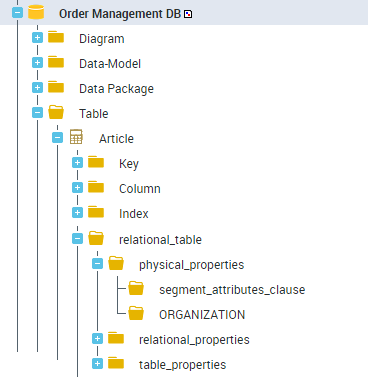
Each parameter group, represented by an "SQL clause" object, has a properties page enabling value definition.
SQL clauses defined in this way are accessible just like repository standard objects. For example it is possible to query SQL objects that have a given parameter value.
By default, clauses cannot be reused from one object to another. It is however possible to define a clause for one object and connect it to other objects. In this case, any modification of the clause affects all objects that use it.
Objects containing physical parameters
Not all objects in Hopex support physical parameters. These concern only:
• Data groups
• Tables
• Indexes
• Clusters
Creating a new clause
To define object parameters:
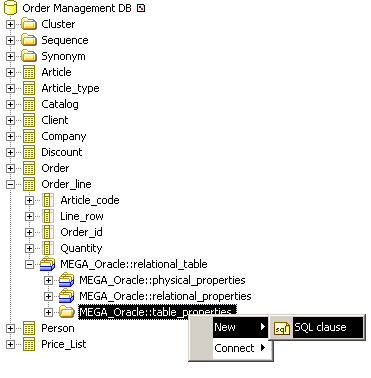
1. Right-click the corresponding parameter group and select New > SQL clause.
2. Open the properties window of the clause and specify the value of the parameter to be defined.
Connecting a clause
You can assign the same clause to several objects, on condition that you connect the correct clause type.
Consider the "Order Management" database with Oracle 9i as DBMS.
On the column "Code_catalogue", create "Clause 1" of type "inline_constraint".
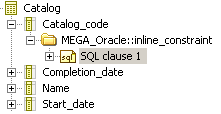
You can connect "Clause 1" to another column. Being the same type of clause, this is copied on the new column with no problem.
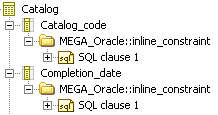
On the other hand, if you connect "Clause 1" to an object of type different from that initially defined on "Clause 1" - for example "Storage_clause" - then "Clause 1" changes type to take that of the last element connected. In other words, "Clause 1" that was type "inline_constraint" takes type "storage_clause". This change is reflected on the start columns to which "Clause 1" was connected.
Naming clauses
Standard case
Specific naming

Multiple clauses
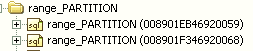
Naming from a property

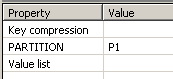
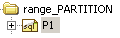
Physical Model Customization Example

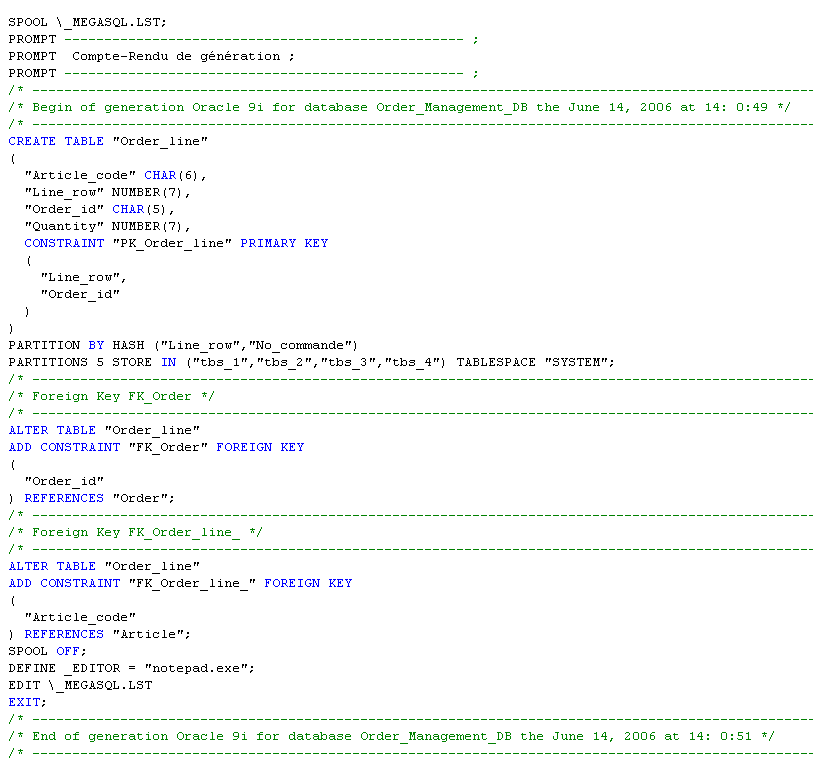
Generating the SQL File
When object customization has been completed, you can generate the corresponding script file to consult the results, without having to regenerate the entire database.
For example, to generate the SQL file of an index:
 Right-click the index and select Generate the code.
See also Generating SQL scripts.