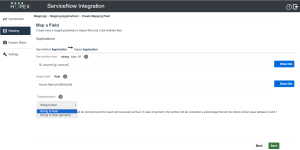
Mapping Fields
To map fields:
• From the Mapping menu, open the relevant mapping.
• Click Add mapping items.
The Map a Field creation page appears.
• Enter the ServiceNow field and the HOPEX field of your choice.
 Click Show list to display all the fields and their characteristics. You can filter the results via the column headers
  .
.• (Optional) Click Use a static value as source to configure a specific value into the target system.
• According to the Field types you selected, Transformation (data conversion) is either automatic or requires manual configuration.
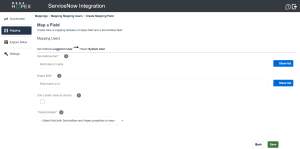
Mapping the name
To map the name:
• Enter "Name" and select the adequate value in the ServiceNow field.
 Objects should have unique names. If objects have the same short name (Software Technologies for example), it is recommended that you use "Display Name" rather than "Name".
• Enter "**NAME**" in the Hopex field.
It is mandatory to use **NAME** - which is a generic local name - so that the adequate value is automatically selected.• Click Save.
Mapping the description
To map the description:
• Enter "Description" in the ServiceNow field.
• Enter "Comment" in the Hopex field.
• Click Save.
 Bear in mind that the ServiceNow description field is not available for all tables and that it has a maximum length of about 1000 characters.
 Field types
Field type | Description |
|---|---|
GUID | Used for absolute identifiers |
String | Used for single line and multiple line text. Formatting is not supported. Strings can be limited in size |
Integer | Used for numbers without the comma |
Float | Used with decimal numbers and percentages |
Boolean | Used with decimal numbers and percentages |
Date | Used to identify date and time |
Enum | Used when a field can hold a predefined list of values. Note that enums in ServiceNow have the "Choice" type. |
Link | Used when the field is a reference to another object. Note that links in ServiceNow have the "Reference" type. See Mapping Links |
Mapping fields of different types
If the fields you want to map are of the same type, then data conversion is automatic (except for specific cases such as enumerations and complex links).
If not, further configuration is required as shown in the examples below.
String to Date
To map a String type field to a Date type field:
 Select the relevant date format of the destination field.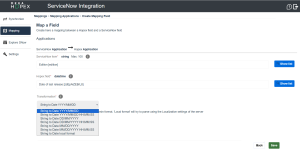
String to Float
To map a String type field to a Float type field:
Select the relevant format of the destination field (number or percentage).