NPV-2 - Programme to Capability Mapping
The purpose of the Programme to Capability Mapping (NPV-2) subview is to primarily support the acquisition and fielding processes, including the management of dependencies between projects and the integration of all relevant project and programme elements to achieve a capability as defined in NATO capability packages (CP).
In NPV-2, programmes and projects are mapped to capabilities to show how the specific projects and programme elements help to achieve a NATO capability, as defined in a CP. Projects are mapped to the capability for a particular time period. Projects may contribute to multiple capabilities and may mature across time periods.
The NPV-2 subview analysis can be used to identify capability redundancies and shortfalls, highlight programme phasing issues, expose organizational or system interoperability problems, and support programme decisions, such as when to phase out a legacy system.
The NPV-2 Report
Report presentation
The Project Deliverables x Capability Increments report of NPV-2 shows the relationship between the capability configuration states defined in NSV-8 and the deliverables produced by the projects that enable reaching the expected states.
This report consists of a matrix with checkmarks that are used to represent mappings between capability configurations (resource architectures) and project deliverables.
You can add or remove mappings by clicking in the different boxes between the capability configurations and the project deliverables.
Report parameters
The NPV-2 report template uses two parameters:
• The Architecture parameter, which identifies the architecture to be analyzed.
• The Projects Subset parameter, which is optional. This parameter reduces the scope of the study to a subset of the projects selected. The selected projects must belong to the architecture. If no project is selected, all the projects of the architecture are taken into account.
• The Capability Increment parameter, which is also optional. this parameter is set with the time periods that you wish to include in the analysis. If no time period is selected, all the time periods of the architecture are taken into account.
The NPV-2 Project Deliverables X Capability Increments Chapter
This chapter shows the relationship between the states of capability configurations and the deliverables produced by the projects implemented to attain the expected states.
This relationship is presented in a matrix with:
• a project tree with deliverables as rows
• time periods as columns.
Checkmarks appear in the matrix to show where a particular deliverables is expected, to ensure that a state of a system part is available. The deliverables are not directly connected to the state but to the time periods of the items that are linked to the states. The time periods are the intermediate notions that group both the states and the items.
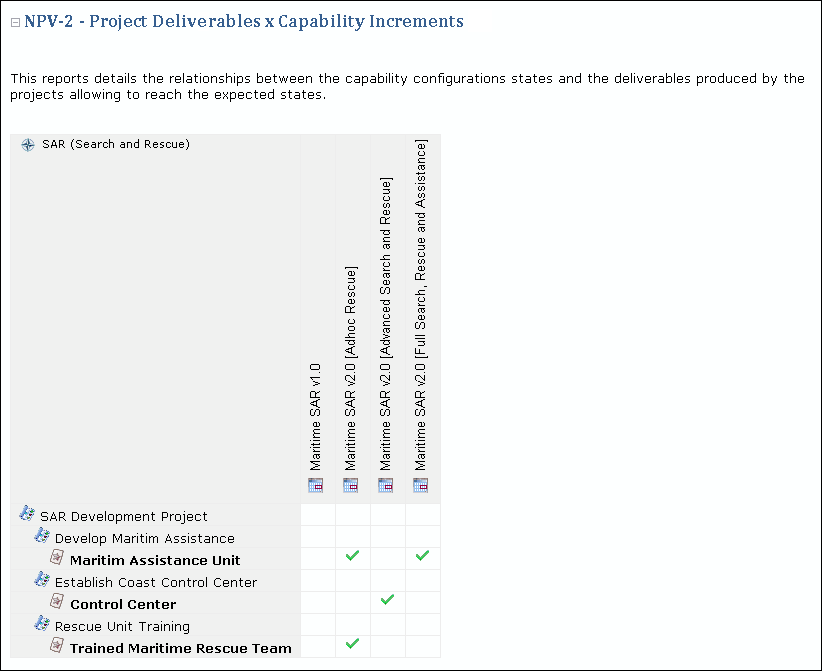
Example of a Project Deliverables X Capability Increments Chapter