NCV-3 Capability Phasing
The NCV-3 subview indicates the planned or available capabilities at different points in time or during specific time periods (states). This is capability phasing.
The different capability time periods (states) are indicated and are associated with milestones. This subview is created through an analysis of programmatic and deployment data in order to determine when system elements from NATO capabilities are to be deployed, upgraded and/or retired. This data may be provided in part by the Programme to Capability Mapping (NPV-2) subview.
The systems identified are structured according to the required capabilities determined in the Capability Taxonomy (NCV-2) subview and the associated timeframes. The projects that can deliver the capabilities within the slated time periods and states are also indicated.
The availability of capabilities at specific times and the deliverables expected can be demonstrated in Master plans, which in the context of information system planning, can be used to define the evolutions of the system that best respond to business function demands. The resource architectures/systems put in place to support the capabilities (capability configuration) are also demonstrated in Master plans. Capability configurations are created in the NSV-1 subview.
Master plans are expected to not only show planned elements at different successive levels and states, but also to provide information on functional suitability of evolutions related to business function expectations, and the impact of the of this Master plan implementation.
 The Master Plans used for the NCV-3 Capability Phasing report are found in the NSV-8 subview. For more information, see NSV-8 Systems Configuration Management.
The NCV-3 Report Template
The NCV-3 report template comes with three parameters:
• The Architecture parameter, which specifies the architecture to be analyzed.
• The Capability Configurations Subset is an optional parameter. You can limit the scope of the study to a subset of the selected capability configurations by setting one or more capability configurations. All the capability configurations of the architecture are used in the study if this parameter is not set.
• The Master Plans Subset, which is an optional parameter. This parameter is used to reduce the scope of the study to a subset of the selected Master Plans. If this parameter is not set, all the Strategic Master Plans are taken into account.
The NCV-3 Capability Configuration Composition Hierarchy Chapter
The capability configuration composition hierarchy chapter presents in tabular form, the elements to be deployed to fulfill certain capability functions. These elements are presented in relation to the hierarchy of the systems that support the capabilities.
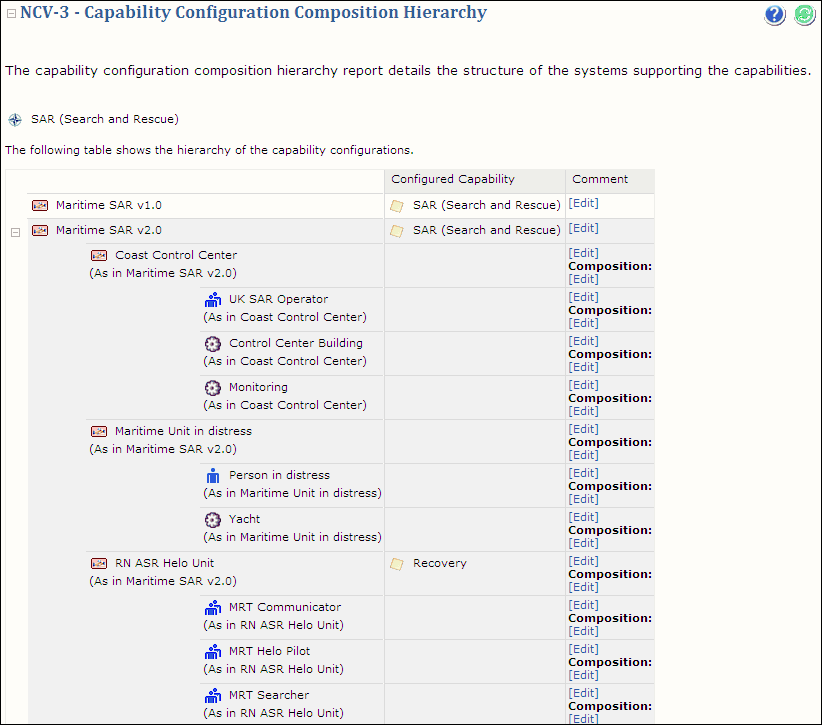
Example of a Capability Configuration Composition Hierarchy Chapter
The NCV-3 Capability Configuration Specialization Hierarchy Chapter
The NCV-3 capability configuration specialization hierarchy shows how the capability configurations of the architecture are specialized.
The varied capability configuration are presented in a table along with their variants. The libraries to which the capability configuration belong as well as the comments of these objects are also indicated.
To create new specializations (variants), use the New > Variant command on the capability configuration to be varied (specialized).The NCV-3 Capability Configuration Generalization Hierarchy Chapter
The NCV-3 capability configuration generalization hierarchy shows how the capability configurations of the architecture are generalized.
The variants of capability configurations are presented in table form along with the varied capability configurations (capability configuration from which the variant was created). The comments and library to which the capability configurations belong are also presented.
To add a new generalization, use the Connect > Variant Of command of the specialized item (variant).The NCV-3 Capability Configuration Dictionary Chapter
The NCV-3 Capability Configuration Dictionary lists all the capability configurations with their definitions. This list is then followed by a dedicated section for each configuration which includes the diagram describing the configuration and the list of configured capabilities in the configuration.
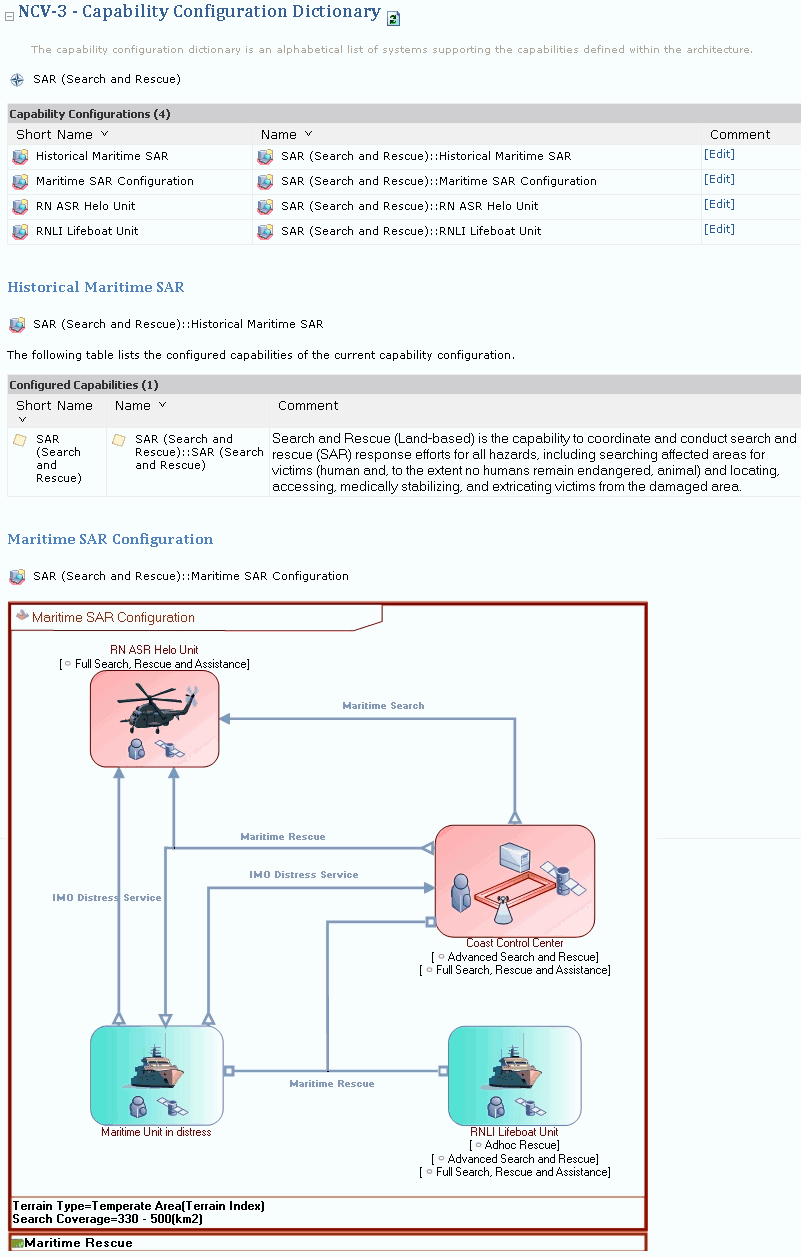
Example of a Capability Configuration Dictionary Chapter
The NCV-3 Capability Phasing Chapter
The Capability Phasing chapter presents a Gantt chart. This chart shows in what way projects, through their deliverables, contribute to implementing the resource architectures that will support the capabilities.
It displays:
• the capabilities (derived from the NCV-2 Capability Taxonomy subview) in rows
• phases defined in the Solution Master Plan in columns.
The capability phasing chapter details the availability of the systems that support the capabilities of the architecture.
These systems represent the resource architectures defined in the NSV-1 subview and attached to the capability to create the capability configuration. Information displayed also include the projects that can contribute to delivering the systems, and the state (time period) of the expected capabilities for each milestone. A matrix with the retrieved projects, their deliverables and the time period (states) in which they are expected can be viewed in the NPV-2 Programme to Capability Mapping subview. The projects retrieved are defined with their deliverables in the NPV-1 subview while the states of the expected capabilities are defined in NSV-10b.
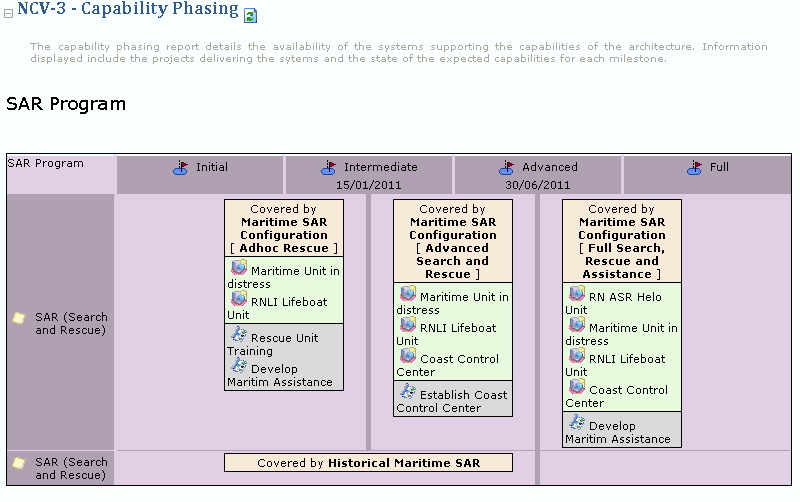
Example of a Capability Phasing Chapter
In the Capability Phasing chapter above, the SAR (Search and Rescue) capability is covered by four different states, three of which have been detailed; "Maritime SAR Configuration [Adhoc Rescue]", "Maritime SAR Configuration [Advances Search and Rescue], "Maritime SAR Configuration [Full Search, Rescue and Assistance]". At the Maritime SAR Configuration [Adhoc Rescue] state, the systems available to support the capability are represented by the Maritime Unit in Distress and RNLI Lifeboat Unit resource architectures. The names of the two projects contribute to implementing the capability during this state; "Rescue Unit Training" and "Develop Maritime Assistance".