Creating Groups
The object descriptor structure is made up of several linked groups organized in a tree. Each group relates to an object and specifies the query or link, which enables passage from the previous object to this object.
Example: You can display the messages sent by each org-unit.
To create a group:
1. Right-click the folder representing the described object (Example: Org-Unit) and select New > Group.
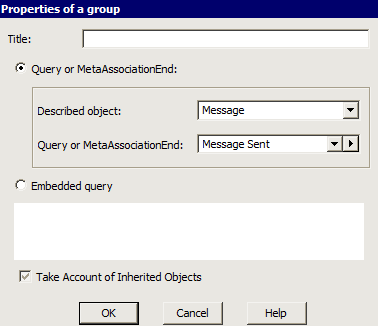
The Group Properties dialog box opens.
2. (Optional) In the Title field, enter a title.
 In most cases, you may choose not to give a Title to the group, since the object and query names provide sufficient information to identify the group.
3. You can select a registered query/MetaAssociationEnd or embed a query. Select either:
• Query or MetaAssociationEnd to select a registered query.
 A MetaAssociationEnd is the extremity of a MetaAssociation linking the MetaAssociation to a MetaClass. Concrete links as well as generic links are proposed in the list of MetaAssociationEnds.
 Example: querying organizational processes linked to an operation, you will see all links connecting these two object types, including the "Behavior" generic link that will find the organizational process describing behavior of the operation.
In the Described object field, select the described object.
Example: "Message" object
In the Query or MetaAssociationEnd field, select the query/MetaAssociationEnd.
Example: “Message-Sent”.
• Embedded query to embed a query that you do not want to save in the repository. If you have a specific need to write a query that will never be reused elsewhere. Enter your query code directly in the corresponding frame.
For more details on queries, see HOPEX Common Features.4. If the general option on variations is activated, the Take Account of Inherited Objects option is displayed.
You can choose to:
• follow default behavior defined at descriptor level (see Descriptors and Inherited Objects): keep the check box grayed:  (or
(or  according to the selected Windows theme).
(or according to the selected Windows theme).• activate or deactivate the option at group level (by selecting or clearing the check box).
5. Click OK.
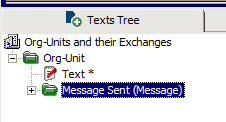
The created group is displayed under the described object folder.
Adding Text to a Group
You can add text:
• before the object
• to the object
• after the object
To add text to a group:
1. Expand the group folder.
See Creating Groups.2. Right-click Before (/After according to where you want to add text) and select Text to add text at the beginning (/end).
Example: select Before to add text at the beginning of the list of messages sent by an org-unit.
3. In MS Word pane, enter the text.
Example: “Messages sent” that you want to display before the list of messages.
4. Apply a style to your text.
Example: "M-List"
See Managing Formats and Styles for more information on styles.
5. Right-click Text and select Close to close the Text editor panes.
6. To add text to the object (Example: “Message sent”), right-click the object and select New > Text.
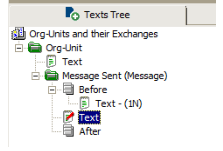
Another Text icon  appears in the tree.
appears in the tree.7. From the Data Tree tab, in the Object characteristics folder, select Name and drag and drop it into MS Word pane.
Example: Add Name and Comment object characteristics
8. (optional) Customize the layout of your document using the styles provided by HOPEX and MS Word.
9. Right-click Text and select Close to close the Text editor panes.
10. (optional) Create other groups.
Example: Create a group that displays the messages received by an org-unit.
Do not forget to save your work from time to time (select Descriptor > Save). Specifying text execution conditions
You can define execution conditions on a "Before" text. You can vary the text according to the number of objects resulting from execution of the query.
Execution condition can be:
• No object: the text is displayed if there is no object
Example: “No message sent”
• A single object: the text is displayed if there is only one object
Example: “Message sent”
• One object or more: the text is displayed if one or more objects
Example: "Message(s) sent”
• More than 1 object: The text is displayed when there are several objects
Example: “Messages sent”
To define text execution conditions:
1. From the descriptor editing window, under the Before folder, right-click Text and select Properties.
2. Select the Execution tab.
3. Select the execution condition.
The text is edited depending on the number of objects found on execution of the query.
Example: The text is edited depending on the number of messages sent by the org-unit
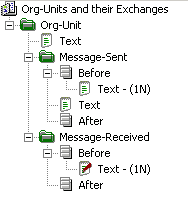 To reorder the descriptor text and groups see Defining the Object Order in Reports (MS Word).