Entities (I.E.)
 An entity represents a person, place, thing or concept that has characteristics of interest to the enterprise. An entity has various attributes that can be stored in the system. Example: Customer, Employee, Order, Invoice, etc.
You can compare the entity concept to sheets in files for example.
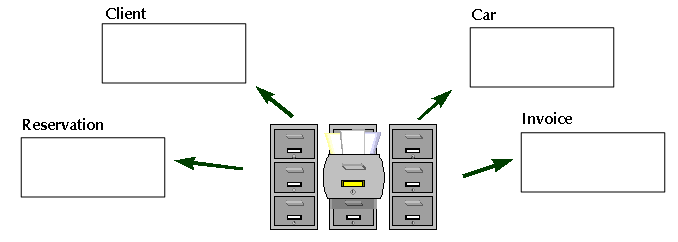
An entity represents a particular object class, of which all instances can be described in the same way. An entity is represented as a square cornered box.
Creating an entity
To create an entity:
1. Select the Entity button  in the objects toolbar by clicking it with the left mouse button.
in the objects toolbar by clicking it with the left mouse button. 2. Click in the diagram.
The Add Entity (DM) dialog box opens.
3. Enter the entity name.
4. Click Create (Windows Front-End) or Add(Web Front-End).
The entity appears in the diagram.
Attributes
Examples of attributes:
• "Client Name" (property of the client entity).
• “Client No.” (identifier of the client entity).
• “Account Balance” (property of the account entity).
An attribute represents a type of characteristic or property associated with a set of real or abstract things. An instance of an entity will usually have a single specific value for each associated attribute. An attribute or a combination of attributes can be an identifier when selected as a means of identification of each instance of an entity.Defining attributes
To create an attribute:
1. Right-click the entity and select Properties.
The entity properties dialog box opens.
2. Select the Attributes tab.
3. To add a new attribute to the entity, click button  .
.
.A default name is automatically proposed for the new attribute. You can modify this name.
You can specify its Data type.
Example: Numeric value.
A datatype is used to group characteristics shared by several attributes. Data types are implemented as classes. See Data Types and Column Datatypes for more details on data types that can be assigned to an attribute.