Setting Up the Connection
To set up the connection between HOPEX and ServiceNow:
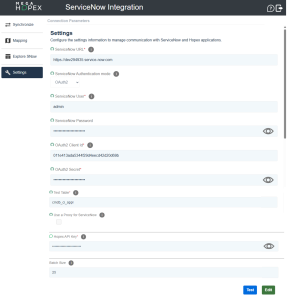
1. In the menu, select Settings.
2. Click Edit.
3. Enter the ServiceNow URL: The URL of your ServiceNow instance.
4. Select the ServiceNow Authentication mode:
• Basic: Can be used for quick set up in non-production environments.
• OAuth2: Recommended for production environments due to its enhanced security and token-based access.
 Further configuration is required in your ServiceNow instance to retrieve the OAuth2 Client ID and the OAuth2 Client Secret. See Setting Up OAuth2.0 in ServiceNow.
5. Enter the ServiceNow User and the ServiceNow Password.
The user must have access to REST APIs and the objects to synchronize.6. (Optional) Modify the default Test Table.
• This table is used to test the connection and the rights of the user.
7. (Optional) Tick the box to set up a Proxy for ServiceNow.
See Setting Up a Proxy.8. Enter an API key.
9. (Optional) Modify the default Batch Size.
• This represents the quantity of objects synchronized in each call to the web service.
The higher the value, the higher the performance. But bear in mind that this may generate errors if the value is higher than the number of objects in each call. 10. Click Test to check whether the connection between ServiceNow and HOPEX is successful.
11. Click Save.
Setting Up OAuth2.0 in ServiceNow
To set up the OAuth2 authentication mode, follow these steps in your ServiceNow instance:
• Ensure the OAuth Plugin is activated
• Set up an OAuth Application
Ensure the OAuth Plugin is activated
To ensure the OAuth Plugin is activated:
1. Navigate to All > System Definition > Plugins.
2. Find the "OAuth 2.0" plugin using the filter criteria and search bar.
3. Check that it appears in the Installed tab.
If not, activate the plugin. 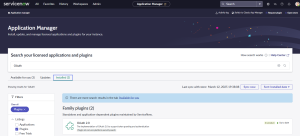
Set up an OAuth Application
To set up an OAuth Application:
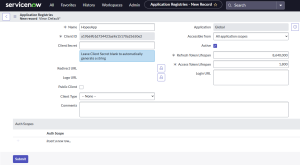
1. Navigate to All > System OAuth > Application Registry.
2. Click New.
3. Select Create an OAuth API endpoint for external clients.
4. Fill in the required fields:
• Name: e.g., HOPEX App
• Client ID: Automatically generated by ServiceNow
• Client Secret: Use the one generated or use a custom one
5. Copy the Client ID and the Client Secret.
Setting Up a Proxy
According to your company security standards, it may be necessary to set up a Proxy.
The Proxy will only affect the communications to ServiceNow.To set up a Proxy:
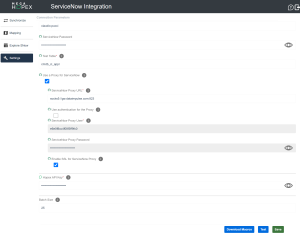
2. Enter a ServiceNow Proxy URL.
• The URL format must be as follows: protocol://url:port where protocol can be: HTTP, SOCKS4, SOCKS4a and SOCKS5.
3. (Optional) Tick the box Use authentication for the Proxy and enter the following information:
• ServiceNow Proxy User
• ServiceNow Proxy Password
According to your specific situation, authentication data for the Proxy can be explicit by filling in the above fields - or implicit in the Proxy URL - or not required at all. 4. (Optional) Tick the box Enable SSL for ServiceNow Proxy.
Creating an API key
Using a dedicated user
 In order to ensure performance, you must use a dedicated user to generate the API key.
You therefore need 2 different users:
• Your regular HOPEX user to access ServiceNow Integration
• A dedicated user to generate the API Key
If needed, see Creating a User.Generating the API Key
To generate the API key:
1. Connect to HOPEX Application Server - Console.
2. Select Modules > Authentication.
3. Select Api keys, then click Create.
• Enter a key Name.
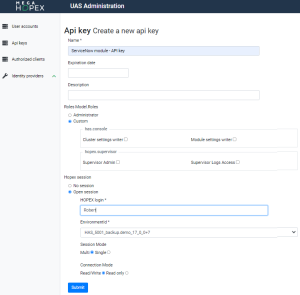
4. Configure the Roles:
• Select Custom
• Leave the fields below blank
5. Configure Hopex session:
• Select Open session
• Enter a valid HOPEX login
Remember that the HOPEX login used to create the API key must be different than the HOPEX login used to access ServiceNow Integration. See Accessing the Module.• Select the EnvironmentId
• Select the Repository if applicable
You need to create one API key per repository.• Select the Profile if applicable
Bear in mind that the profile you use must have sufficient CRUD rights on the objects that will be synched. 6. Configure Session mode:
• Multi (recommended)
• Single (slower and requires more memory)
7. Configure Connection Mode field:
• Read/write (recommended)
• Read only (can be used only if you synchronize data from HOPEX to ServiceNow)
8. Click Submit.
9. Copy the key.
Save the key somewhere: you will not be able to access it at a later stage.  If you have lost the API key, you can simply create a new one. This will not impact ServiceNow Integration.