Describing Business Capabilities and the existing architecture with HOPEX Digital Transformation Desktop
To access elements describing business capabilities and architecture:
1. Click the navigation menu, then Strategic Planning.
2. In the navigation pane, click Inventory.
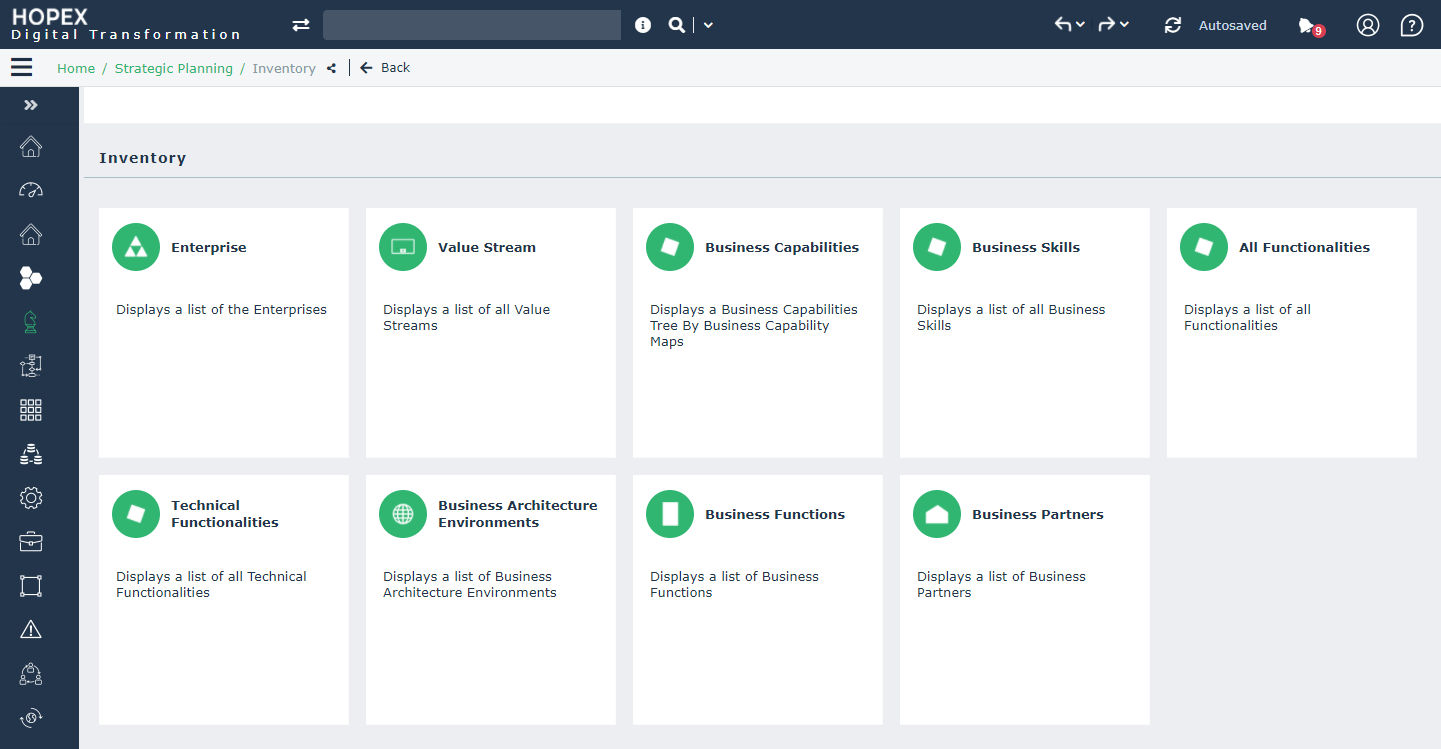
The list of main tiles for the transformation projects management appears.
• Enterprise,
 An Enterprise is a purposeful undertaking, conducted by one or more organizations, aiming at delivering goods and services, in accordance with the enterprise mission in its changing environment. During its development over time, an enterprise has to adapt to its environment and sets up transformation goals and objectives along with course of action to achieve these objectives. The design and realization of the resulting transformation stages may transcend organizational boundaries and consequently require an integrated team working under the direction of a governing body to involve stakeholders in transformation initiatives. This requires the implementation of an integrated team, under the responsibility of a governing body, to involve the stakeholders in the transformation.
• Value streams,
A value stream is an end-to-end collection of Value Stages that creates an outcome for a customer, who may be the ultimate customer or an internal end-user of the value stream.
• Business Capabilities
.A business capability is a set of features that can be made available by a system (an enterprise or an automated system).• Business skills,
A business skill is a capability acquired by a person or an organization through a specific training.• Functionalities and technical functionalities,
A technical functionality is a capability expected from an equipment item (hardware or software) to ensure the operation of a technical element or an application.A technical functionality is a capability expected from an equipment item (hardware or software) to ensure the operation of a technical element or an application.• Business architecture environment,
A business architecture environment represents the relationships of a business functional area with its partners.• business functions.
A business function is a conceptual unit of the division of responsibilities in an enterprise. It is used to structure the management of information processing, energy, and equipment produced or used. Business functions define the skills and the functionalities necessary to the enterprise to fulfill its mission.• Business partners,
A business partner designates a third-party who is in relation with the enterprise within the framework of a given business architecture environment. Examples: private sector client, regulatory organization, supplier.