2. Upgrading a HOPEX bundle
This procedure applies to both single server deployment and cluster deployment. It is required to download and install bundle on each server
Pre-conditions:
• Identify the bundle to install (target bundle).
Ex: 5.0.1 +384 (HOPEX V5.0 CP1)
This information is usually provided by MEGA Technical Support.
Ex: 5.0.1 +384 (HOPEX V5.0 CP1)
This information is usually provided by MEGA Technical Support.
• Identify the url of the HAS Instance Manager Console
Ex: http://localhost:30100/
Ex: http://localhost:30100/
• Identify the HAS instance to upgrade (target HAS instance)
Ex: preproduction instance http://svr0101:5001/
This information is provided by the project.
Ex: preproduction instance http://svr0101:5001/
This information is provided by the project.
• Know the credentials for the HAS Console of this instance.
This information is provided by the project.
This information is provided by the project.
• Know the credentials for the Instance Manager Console.
This information is provided by the project.
This information is provided by the project.
• Check that no user is connected to the HAS instance.
2.1. Update of Instance Manager
Certain CP require an update of the instance manager program.
|
Condition
|
Update of Instance Manager
|
Comment
|
|
From HOPEX V5.0 to HOPEX V5.0 CP1
|
Not needed
|
|
|
From HOPEX V5.0/HOPEX V5.0 CP1 to HOPEX V5.0 CP2 or higher CP
|
Needed
|
ASP.NET Core runtime 6.0 (hosting Bundle) is required.
Update is no longer needed once new version of Instance Manager (15.2.0.49 or higher) is installed
|
Update of instance manage is performed systematically is you run HOPEX installer, for example new installation or offline installation.
To perform a new installation, read document HOPEX Application Server Installation in online documentation for HOPEX V5.0
Note that, if the expected version of .NET core is not installed, the Instance Manager will not restart. Verify that this pre-requisite fulfilled before running the setup.exe.
2.2. Online procedure (internet access):
The procedure applies to a HAS instance.
Here, it is assumed that:
• You can access to HOPEX store https://store.mega.com.
• You have an installation key.
For each HAS instance:
2. In the left menu, select HAS Versions
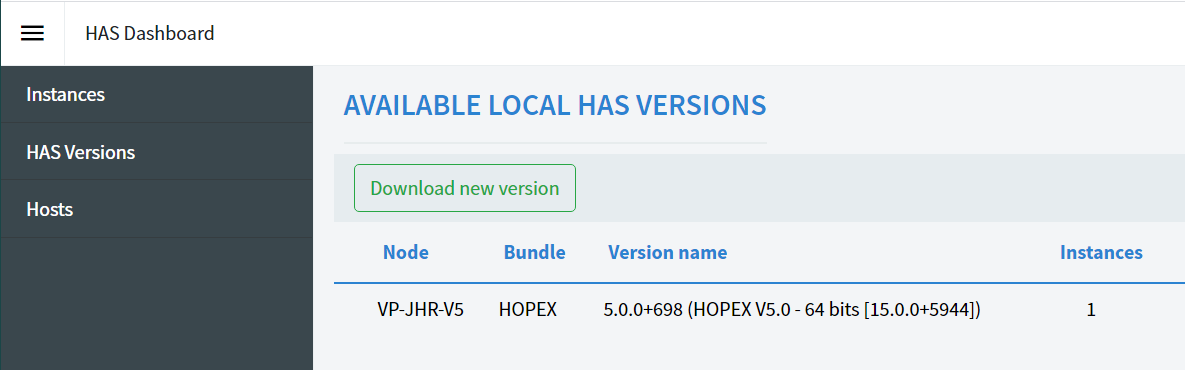
3. Click on button Download new version.
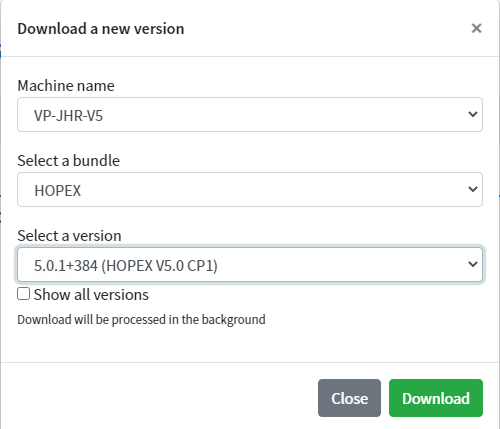
4. Select carefully the version to install (ex: 5.0.1 +384 (HOPEX V5.0 CP1) in the list and click Download.
5. Wait a few minutes up to the end of the download (100% then extraction).
A new folder is created in C:\ProgramData\MEGA\Hopex Application Server\.binaries\HOPEX, ex V5.0.1+384
A new folder is created in C:\ProgramData\MEGA\Hopex Application Server\.binaries\HOPEX, ex V5.0.1+384
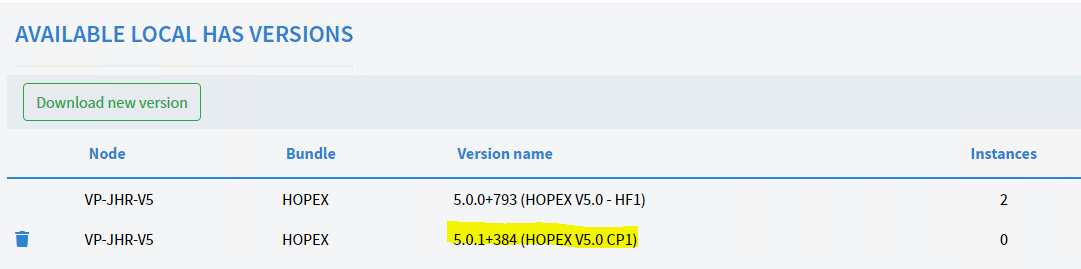
6. In the left menu, select Instances
7. Select the target instance and click Stop and confirm action
HAS instance stops (status Stopped)
HAS instance stops (status Stopped)
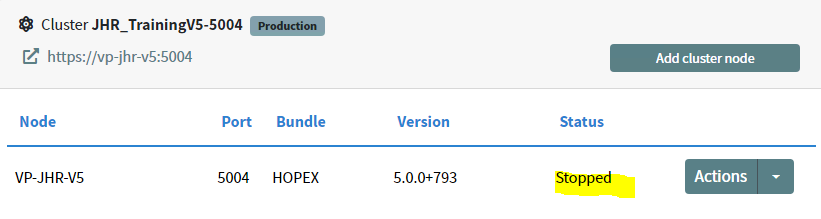
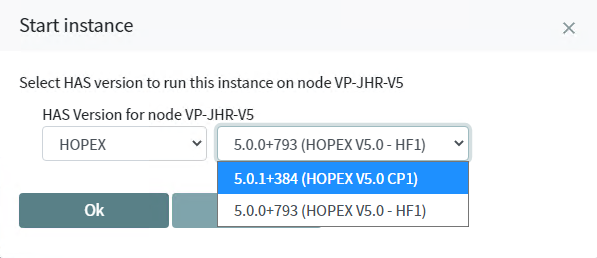
8. . Select the target instance and click Actions > Start
9. In the page 'Start instance', select carefully the target bundle ex: 5.0.1 +384 (HOPEX V5.0 CP1) and click OK
HAS instance starts
HAS instance starts
10. In the left menu, select HAS Versions
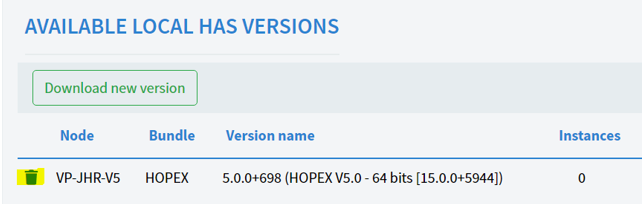
11. You can delete previous programs (ex 5.0.0+698) in there no associated instance by clicking on the dustbin icon
12. Open HAS Console related to the target instance and check that all module as loaded
2.3. Offline procedure (no internet access):
The procedure applies to a HAS instance.
Here, it is assumed that you have received a folder containing an offline package (downloaded previously).
To create an offline package, read document HOPEX Application Server Installation in online documentation for HOPEX V5.0
Browse the folder containing the offline package related to the hotfix.
It must contain:
1. A file has.setup.exe.
2. A folder .haspackages.
Procedure:
1. Run has.setup.exe as an administrator.
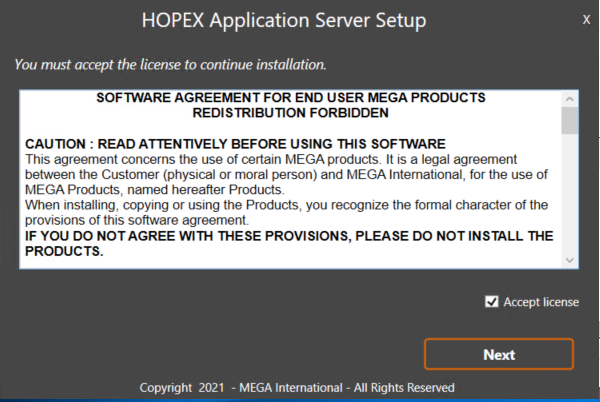
2. Check Accept license and click Next.
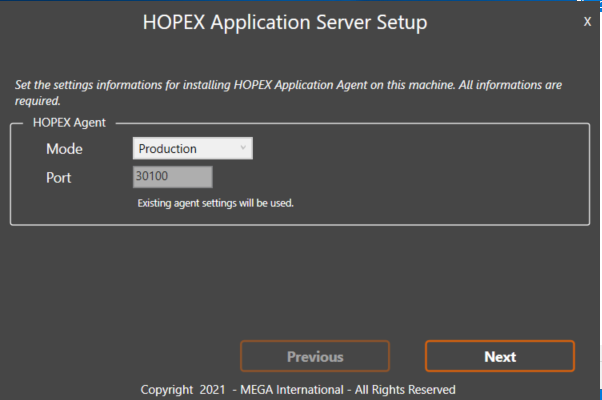
3. Keep existing settings for HOPEX Agent and click Next.
4. The package is installed
A message is displayed such as 'installation completed successfully'.
A message is displayed such as 'installation completed successfully'.
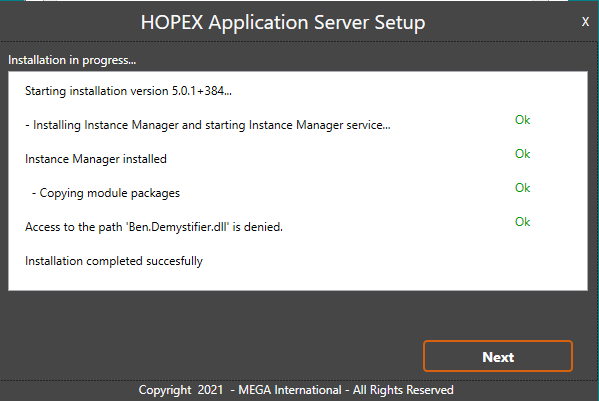
5. Click Next
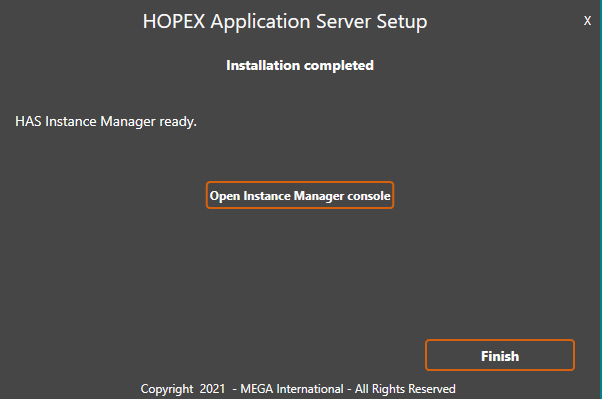
6. Click Open Instance Manager console
7. Login to Instance Manager console
8. In the left menu, select Instances
9. Select the target instance and click Stop and confirm action
HAS instance stops
HAS instance stops
13. . Select the target instance and click Actions > Start
14. In the page 'Start instance', select carefully the target bundle (ex: 5.0.1 +384 (HOPEX V5.0 CP1) and click OK
HAS instance starts
HAS instance starts
15. In the left menu, select HAS Versions
16. You can delete previous programs (ex 5.0.0+698) in there no associated instance by clicking on the dustbin icon
17. Open HAS Console related to the target instance and check that all module as loaded