About HOPEX Administration
This guide is for the person responsible for administrating users and objects from the HOPEX Administration desktop (Web Front-End).
 To perform HOPEX administration tasks from the HOPEX Administration application (Windows Front-End), see About HOPEX Administration.
Some actions, like user management, can be performed by functional Administrators from a restricted Administration desktop accessible from other HOPEX desktops (Web Front-End).
Most of the functions described here can be used by the User management administrator, whatever the products enabled through his/her security key. However, certain functionalities, like object management are only available with specific technical modules (HOPEX Power Studio or HOPEX Power Supervisor). These are indicated by a note.
See:
• Managing Users: creation of users, user groups and their profiles.
• The HOPEX Power Supervisor technical module is necessary to manage profiles.
• The HOPEX Power Studio technical module is necessary to create profiles.
• Managing Workspaces: principle of private workspaces, dispatch and refresh private workspaces, and lock management.
• Managing objects: Advanced administration functions available with:
• the HOPEX Power Studio technical module to extract objects
• the HOPEX Power Supervisor technical module for access management to the UI.
• Command File Syntax: description of the syntax used in command files.
• Managing Options: access to options, user level options and language management.
• Glossary: definition of the main terms used in this guide.
HOPEX structure:
Some basic knowledge is required to understand the architecture and operation of HOPEX.
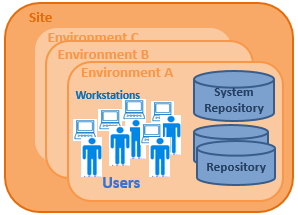
HOPEX (Web Front-End) is organized on the following levels:
• site
A site groups together everything that is shared by all HOPEX users on the same local network: the programs, standard configuration files, online help files, standard shapes, workstation installation programs, and version upgrade programs.
• environment
An environment groups a set of users, the repositories on which they can work, and the system repository. It is where user private workspaces, users, system data, etc. are managed.
• user
A user is a person (or person group) with a login. A user:
• has a specific workspace in each repository.
• has a specific configuration and is authorized to access specific product functions and repositories in the environment.