Viewing Control Directives
Control directives correspond to the imported UCF Controls.
 For more details, see Main Concepts Used in UCF.
Control directives are an interpretation of the law and contribute to the enforcement of any regulation article your organization has to comply with.
Accessing control directives
To access control directives from a tree:
 In the navigation menu, select Libraries > Control Framework > By Control Directive.
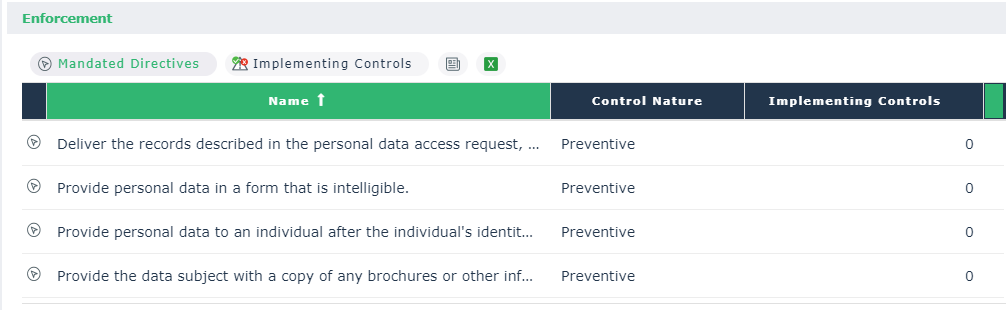 First-level Implied control directives appear in this list only if one of their children is mandated.
 The following information is displayed for each control directive:
• Enforcement Level
• Number of Supporting Directives.
Information is also given on HOPEX controls implementing each control directive:
• Number of Implementing Controls.
• Execution rate
The execution rate relates to control execution check-lists. It indicates the percentage of controllers which have successfully executed the controls implementing the control directive.• Control pass level: gives an indication on how adequate and how effective the control is (Control Design (IC) * Control Efficiency (IC)).
For more details on control contextualization see Executing controls.Viewing fulfilled regulation articles
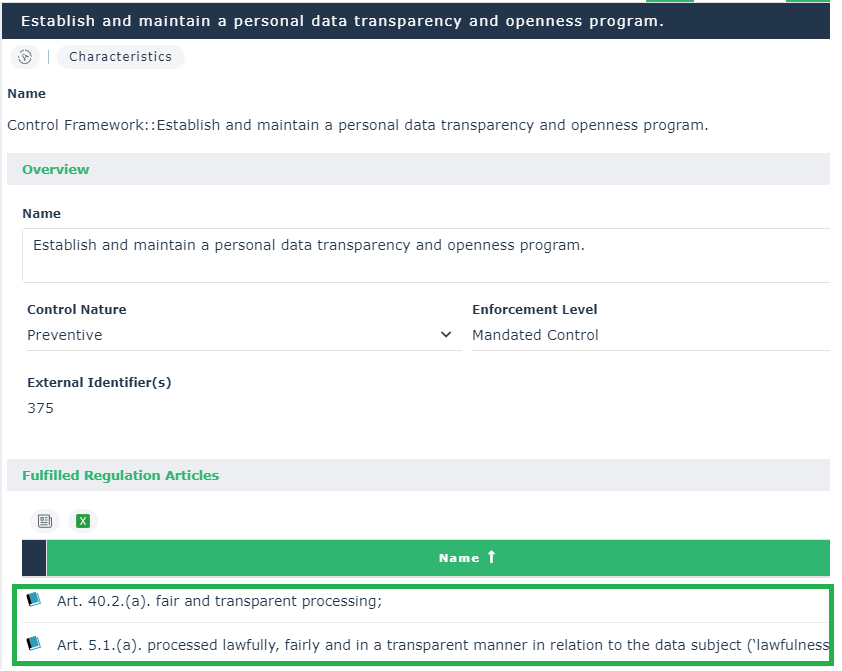
A mandated control directive is associated to a regulation article.
It is beneficial to have several regulation articles in the Fulfilled Regulation Articles section of a control directive. It means that your control directives enforce compliance of your organization to several regulation articles.
Supported and supporting directives
All control directives are presented in a tree structured around the control directives supporting one another, as originally defined in the UCF Common Control Framework.
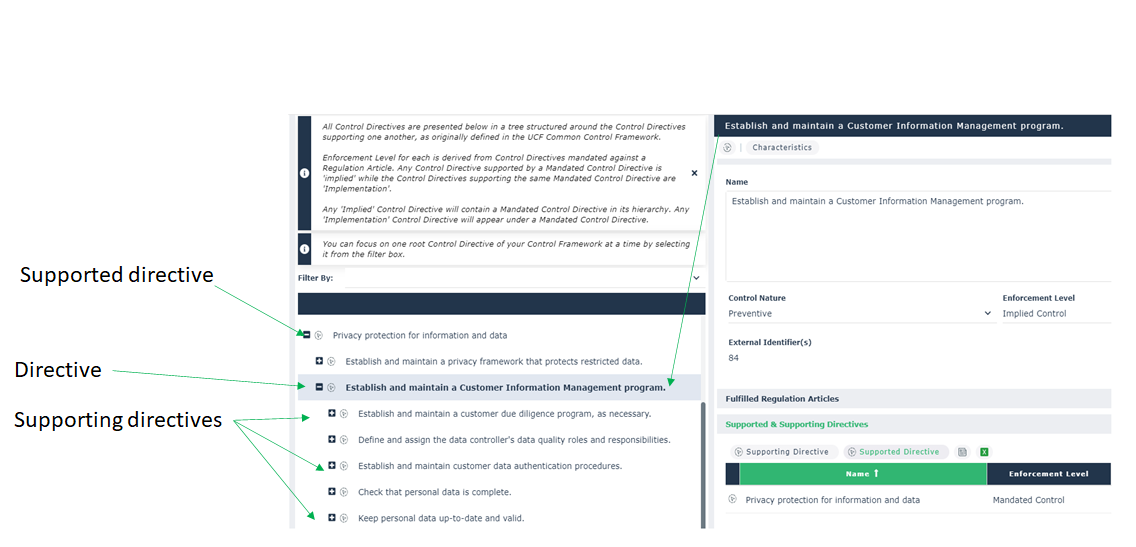
Having several control directives in the Supported Directive tab of a a control directive is highly beneficial. This means that efforts spent implementing one mandated control directive also contributes partly to the implementation of its supported control directives.
Enforcement level of control directives
There are three enforcement levels for each control directive:
• mandated
 a mandated directive is directly associated to a regulation article. It implements a regulatory framework.
• implied
An implied directive is a non-mandated control directive that is a parent of a mandated directive. It indicates that one of the control directives contained within its supporting hierarchy is mandated. • implementation
An implementation directive is a non-mandated directive that is a child of a mandated directive. It provides details regarding how to carry out the mandated directive and facilitates its implementation.Enforcement level for control directives | |
|---|---|
Implied control directive | - Is not mandated - Contains at least a mandated control directive in its hierarchy - Allows to display the mandated control directives within the UCF hierarchy - Is supported by a mandated control directive |
Implementation control directive | - Is not mandated - Appears under a mandated control directive (is supporting a mandated control directive) |
Mandated control directive | - Is supporting an implied control directive - Can be supported by implementation control directives - Can support or be supported by other mandated directives |
Viewing HOPEX controls implementing a control directive
Columns in the list of control directives give you an overview of HOPEX controls that are actually implementing each control directive.
To have a more detailed view of the controls implementing a control directive:
1. In the navigation menu, select Libraries > Control Framework > By Control Directive.
2. Open the properties of a control directive.
3. Expand the Implementation section.
You are given information on the control as well as on its execution results:
• Control nature
• Aggregated Execution Rate
The execution rate relates to control execution check-lists. It indicates the percentage of controllers who have successfully executed this control whatever the context.• Control Pass Level
For more details on control contextualization see Executing controls.Connecting Business Documents
You can attach business documents in the properties of a control directive.