The HOPEX Business Architecture method
The method described in this guide is represented in the schema below.
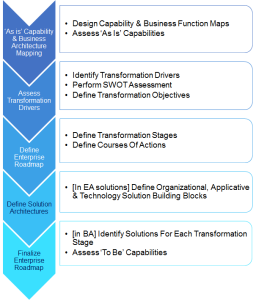
Description of business capabilities and the existing architecture: this first step consists, on the one hand, in defining what the enterprise can deliver (business capabilities), and on the other hand, in defining how it can be structured to deliver this (business functional area). For a business capability, you can identify the KPI dimensions of interest for the capability which are used to assess business value and performance (e.g.: for a delivery capability, we are interested in the "delivery time" expressed in minutes).
 For more details on business capabilities, see Building capability maps and business function architectures.
Assessing the transformation drivers: this second step is based on gathering and assessing (SWOT) drivers. The enterprise goals are then deduced from this step.
For more details on transformation drivers, see Identifying enterprise goals.this third step is based on the description of the operational systems of the enterprise, performed during the first step as well on the transformation driver analysis, to schedule the changes foreseen to reach the enterprise goals and thus define the courses of action (strategies and tactics) to be implemented with a view to achieving the defined goals and specify the exhibited business capabilities for each enterprise stage.
For a given exhibited business capability, in a given stage, you can define the key performance indicator (KPI) that is used to define the expected service level requirement, when implementing the capability for the enterprise transformation stage in question (e.g.: for a for a “product delivery” business capability, we expect, for the 'delivery time' KPI dimension, a "delivery time < 30 minutes" in a first enterprise transformation stage, then a "delivery time < 20 minutes" in a later enterprise stage).
For more details on the road map, see Defining the transformation roadmap.Defining the solution architectures: this fourth step can be performed by using HOPEX Business Architecture and the Enterprise Architecture solutions jointly; it is used to identify and describe the existing and target solution building blocks and to identify which business capabilities (or business functions) they contribute to implement.
The additional solutions of the HOPEX platform are used to describe in more detail your target organizational models (organizational, application and technological solution building blocks).
For more details on solution architectures, see "Describing implementation of an enterprise stage", page 94.Finalizing the driver roadmap: this last step aims to finalize the transformation roadmap, in association with each solution environment required to achieve the enterprise goals.
The order of these steps is given by way of information. To define a finalized transformation roadmap, several iterations of this cycle should be performed.This presentation is based on the example of a pizza making and delivery company that has decided to reorganize itself to ensure pizza delivery and improve product quality.