Defining the transformation roadmap
This step consists of planning the means (strategies and tactics) to implement to reach the transformation goals identified during the previous step for a given enterprise stage.
 An enterprise is a purposeful undertaking, an effort conducted by one or more organizations, aiming at delivering goods and services, in accordance with the enterprise mission in its changing environment. In the course of its development, the enterprise must adapt to its environment and establish the transformation objectives and goals to be achieved as well as the strategic action plans used to achieve these objectives. The development and achievement of the different adaptation and transformation stages can lead to a modification of the organization's boundaries. This requires the implementation of an integrated team, under the responsibility of a governing body, to involve the stakeholders in the transformation.An IT transformation stage is an enterprise transformation stage aimed at aligning the enterprise IT system with the functionalities expected by the operations.A business transformation stage is a kind of enterprise transformation stage aiming at the alignment of the enterprise operating model to its strategy and corresponding exhibited business capabilities.
Defining the enterprise and its events
An event represents a fact or an action occurring in the system, such as updating client information. It is managed by a broker. An application indicates that it can produce the event by declaring that it publishes it. If an application is interested in an event, it declares that it subscribes to the event.A transformation stage is a past, current or future stage of an enterprise.An enterprise is itself an enterprise stage; it is therefore possible in HOPEX Business Architecture to define business capabilities and enterprise models for courses of action directly at the level of the root enterprise, and refine the iterative roadmap drill down into the subsequent stage levels.
A basic enterprise is made up of the following elements:
• a start enterprise event;
 The start event can be positioned arbitrarily at the beginning of the current year, for example.
• an end enterprise event;
The end event can be positioned with an analysis time frame (e.g.: year n+ 5, year n+10)• a current ('As-Is') enterprise stage that holds the currently deployed business capabilities map, the business architecture environment and the solution building blocks;
The end event of this stage is the intermediate event that defines the 'pivot' transformation benchmark beyond which you are in the 'target' stage• a target ('To-Be') enterprise stage that holds the target business capability map, the business architecture environment and the target solution building blocks.
The start date is the end pivot event of the previous ('As-Is') stage.For more details on enterprise stages, see "Defining enterprise stages", page 96Defining enterprise stages
An enterprise stage is defined by a number of components.
• A business capability map, which contains the capabilities valid for the current enterprise stage;
• A business function architecture environment, which contains the elements that define the enterprise model (operating model) for the current stage.
• the definition of the ecosystem of the enterprise (interactions with partners),
• the business function architectures,
• the business functions.
• The solution building block environments that depend on product licenses used, for example:
• with HOPEX IT Architecture, the environment for Logical Application Systems, the environment for Application Systems, the environment for Resource Architectures, etc.
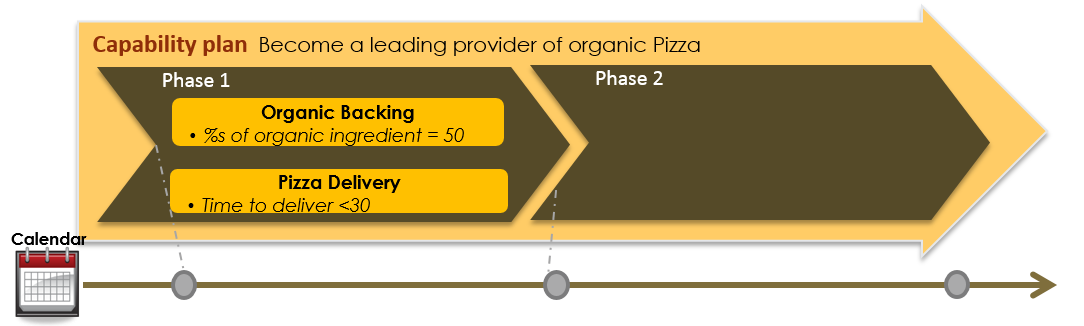
Defining the transformation roadmap
From an enterprise or an enterprise stage, you can define enterprise sub-stages. Each enterprise sub-stage is positioned in the main enterprise according to the main enterprise events, in order to define the transformation roadmap for the enterprise underway.
For more details on transformation plans, see "Drawing up the roadmap", page 93.The transformation roadmap is presented in the form of a Gantt chart.
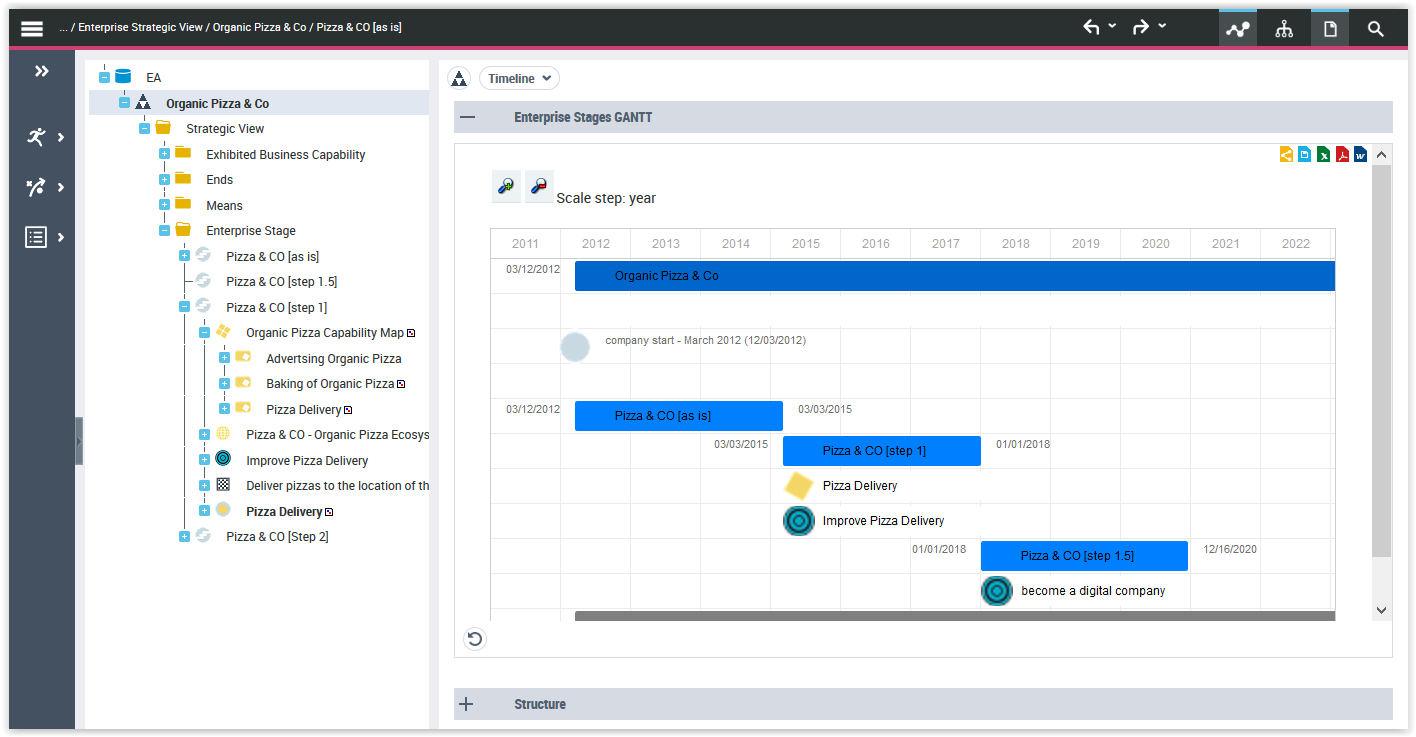 For more details on Gantt diagrams, see "Using Gantt Charts", page 99.