City Planning Level
The information system processing is broken down into different levels:
• Area
This is the highest level in the breakdown of the enterprise information system. For most companies, there is a data acquisition area, an information processing area, a management area, a repository area, etc.
• District
The district groups the processing that can correspond to an activity or a business function, and therefore to a type of information.
• Block
The block corresponds to the basic component of the city planning. A block is a homogeneous set of data and processing. Computer applications are grouped within the city planning blocks.
• etc.
 Additional levels can be specified if required.
Areas and Sub-Areas
"Sub-areas" can be created from an area, whatever the city planning level ("area", "district" or "block").
• In a city plan, when you create a sub-area from an "Area" (right-click the city planning area New > City Planning Sub-Area), the sub-area automatically becomes an area of "District" level.
• In a city plan, when you create a Sub-area from a "District", the sub-area automatically becomes a "Block".
The appearance of the area changes according its city planning level.Properties of areas, districts and blocks
To view the City planning level of the area:
 Open the properties dialog box of the area.
The Color attribute brings a further dimension to your city planning diagrams. The value given to this attribute changes the shape color representing the area, district or block displayed in the diagram.
The City Planning tab is used to specify the applications, databases, services, or use cases concerned.
Example of breakdown into areas, districts and blocks
For this purpose, we will use a fictitious enterprise called "Voyages & Vacations".
The Voyages & Vacations company was originally a sailboat manufacturer.
To sell and rent its sailboats, the company developed a network of offices and travel agencies in tourist destination islands such as the Caribbean Islands and Hawaii, as well as in major cities around the world. It also developed a network of banking offices to finance the purchase of its boats by private parties.
As technology changed, the original activity of boat construction declined, until only the activity of manufacturing spare parts for boats remained.
However, the boat rental and sales activity grew enormously. The company now offers pleasure boat rentals of all sorts, including both sailboats and motorized craft, and related services such as diving equipment rentals, car rentals, hotel reservations, and airline ticketing. It also now has several cruise ships and its own restaurant chain.
The company is organized into three main subsidiaries:
• The Voyages & Vacations company, which manages the rental of pleasure or cruise boats and related activities such as hotel reservations and airline ticketing.
• The MyBank company, where the banking activities of the group are handled.
• The HBC company, which manufactures and sells spare parts for boats.
Here is a detailed list of the various activities of the group:
• Boat rentals for boats of all sizes
• Airline ticketing and hotel reservations
• Car rentals
• Organizing cruises
• Organizing corporate seminars
• Managing technical documentation on boats
• Managing boat parts and boat repairs
• Purchasing boat parts
• Manufacturing and selling boat parts
• Managing libraries so books are available to passengers
• Managing the ATMs available to passengers on cruise ships
• Managing stock orders for passengers on cruise ships
• Other banking services
• Catering services on-premises or in the home
To contribute to the introduction of new applications into its information system, and to facilitate moving existing applications onto the Internet, the company IS manager began to map a city plan for his information system.
The following diagram shows a functional city planning diagram for this information system.
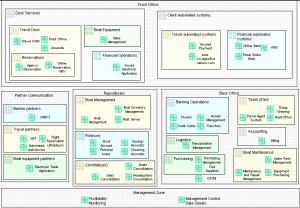
Functional city planning diagram for the information system
The information system is divided into areas, based on their interactions with the customers and partners of the company.
The color of the areas, districts, and blocks represents the subsidiary where these areas, districts, and blocks originate: Voyages & Vacations in yellow, HBC in green, and MyBank in blue.Data Acquisition Area
The first area, called the "Front Office", contains applications that are in direct contact with the customer. This area is divided into two districts:
• "Client automated systems", which are automated systems used directly by the customer without any intervention by company personnel, such as Internet reservation systems or automated teller machines.
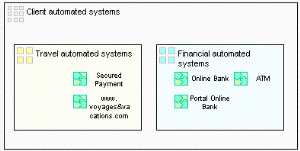
"Customer automated systems" district
This district is divided into two blocks, one containing the systems used for managing travel, the other the financial systems.
• "Desk services" district, which are services provided by people in the company, in the presence of the customer. These include travel reservations.
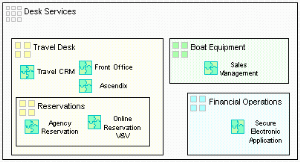
"Desk services" district
This district is divided into three blocks, one containing the applications used for travel management, one containing the financial operations, and a third the applications used for the sale of boat equipment. A specific sub-block has been identified for managing reservations.
Data Processing Area
A second area, called the "Back Office", contains the applications used for customer service that do not require the customer's presence.
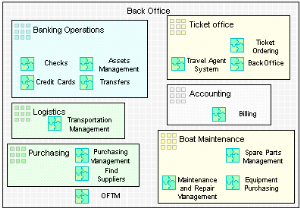
"Back Office" area
This contains various districts, dedicated to "Banking operations", "Ticket office", "Logistics", "Purchasing", "Boat maintenance", and "Accounting".
Other areas
The "Repositories" area contains the applications used for accessing the persistent data of the enterprise.
The "Management" area contains the applications used by corporate management to direct the corporate strategy. These are generally statistics or performance indicators determined by compiling the persistent data in the enterprise repository.
It may also be useful to define an area for communication with business partners, particularly suppliers.