Technical Infrastructure Diagram
The Technical Infrastructure Diagram (TID) focuses on software architecture strategic objectives.
This type of diagram (Technical Infrastructure Diagram or TID) provides a detailed description of the technical architecture: network management, information flows, routing.
The TAD also allows you to choose the correct hardware configuration for your applications and databases, plus the networks used to exchange information.
TADs focus on describing the networks and servers.
A technical infrastructure diagram can be used to define a "Technical infrastructure overview" of the enterprise, or to create the specific "Technical infrastructure diagram".
Basic TID Concepts
Within the described scope, the TID shows:
• the networks used to send information and connect client workstations to servers.
• for each site, the servers where the applications and databases are installed.
• the workstations and their installed applications and databases.
• the network nodes such as printers, modems, etc. These nodes can be connected to each other or to servers.
• the sites where networks, servers, workstations and other types of hardware are installed.
• the information flows exchanged by applications, databases, and external org-units. These messages can be sent across a network.
• the external org-units that send or receive messages used by applications.
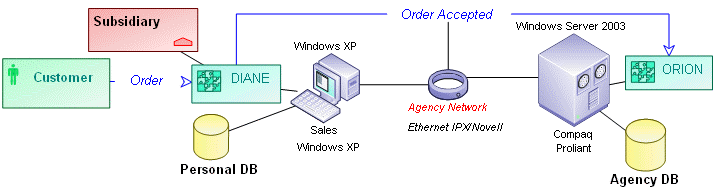
Organizational elements: org-units, etc.
A TID can be enhanced by adding organizational elements.
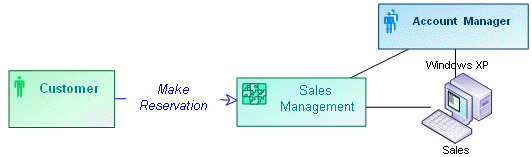
• For example, you can indicate the org-units that use an application across the network. This application must be accessible from the org-unit workstation.
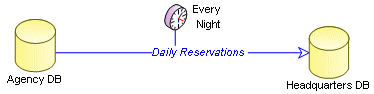
• If a message describes a file transfer, you can use a timer to indicate when to transfer this file.
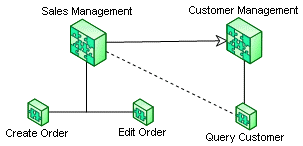
Distributed processing
You can distribute processing between a client application and a server application. You can indicate which services on the application server are used by the client.
Specialization
You can indicate sub-types for org-units, sites and messages.
Main Uses of the TID
Depending on the scope of your analysis, you can choose to build an overview of the information system architecture, or you can detail a part of it: for example, in a general overview you can indicate the methods of communication used between the different sites in your organization; in a detailed view, you can focus on one specific site to describe the technical infrastructure of this part of the information system.
The global view of an information system maps the geographical locations of the organization and shows communication between sites. This approach highlights the networks and servers used, as well as the applications and databases that send or receive information.
The detailed approach focuses on describing a specific site, in order to analyze and represent the technical infrastructure of the local information system and its main links with its environment. This type of approach highlights local area networks, the servers where the applications and databases are located, the connected workstations, and the peripherals used (printers, modems, etc.).
The detailed approach also allows you to describe a specific local area network, all the connected hardware, and all installed applications and databases.