Describing a Use Case of a Project
Creating use cases of project components enables representation of the different use contexts of the system. From a use case, you can describe how a functionality or set of functionalities is implemented within an application or service.
By means of use cases, HOPEX Application Design enables addition to description of an application architecture of the detailed specifications of its different sub-systems.
Example of a Use Case
A use case diagram enables description of interactions between a system and actors of the organization.
 A use case is a series of actions leading to an observable result for a given actor. Scenarios illustrate use cases for example.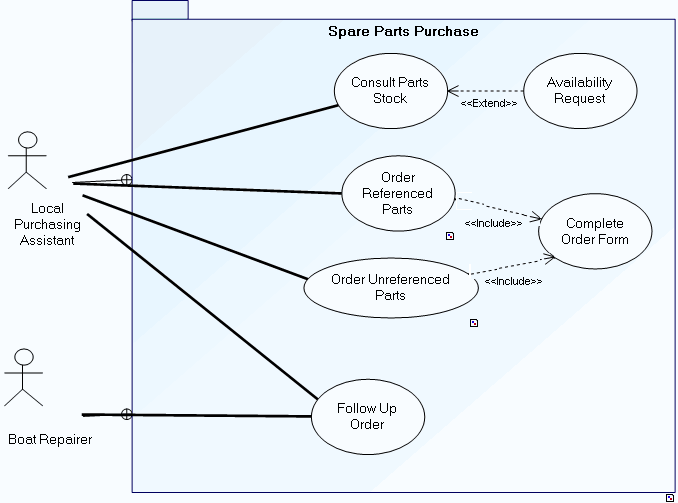
The system is used to consult parts in stock and to order new spare parts.
Consultation of parts in stock is carried out by the local on-site purchasing assistant. Following consultation, the assistant can make an availability request.
Two order types are possible, one for parts already referenced, the other for parts as yet unreferenced. In both cases, an order form should be completed.
Order follow-up is assured by the local purchasing assistant and the boat repairer.
Creating a Use Case Diagram for an Application Environment:
Prerequisite
• You must first define a work environment for a project in progress. See "The Current Design Project pane", page 21.
• An application environment must also be created. See Describing an Application Environment.
To create a use case diagram from an application environment:
1. Click the navigation menu, then Current Design Project.
2. In the navigation window, select Functionality and Rules Design.
3. Click the Application Environments tile.
The list of application environments appears in the edit area.
4. Right-click the application environment concerned and select New > Application Environment Use Case Diagram.
The diagram opens in the edit window.
Use Case Diagram Elements
For a complete description of the use case diagram, see "Use Case Diagram".