Presentation of HOPEX Application Design
Combined with the products of the HOPEX suite, HOPEX Application Design offers a methodology and the tools to describe and plan your business transformation.
The scope covered by HOPEX Application Design
To assist architects in describing software specifications, the HOPEX Application Design solution is based on the following methodology:
• Defining the project and its application scope
• Capturing business needs and project objectives
• A functional analysis and description of use contexts
• Modeling application data flows (data scope)
• Designing the technical architecture
A validation workflow offers the end client the possibility to validate the specifications by ensuring that its needs are met.
The solution interface follows this methodology. For each step, the solution supplies users with specific tools for each step.
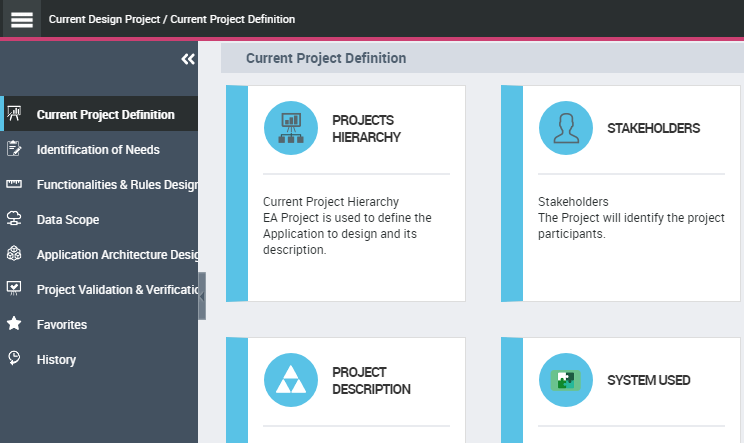
The phases offered in standard mode are in keeping with an Agile development approach.
Analysis reports are available to simplify analysis of the subject and contribute to the development of complete and relevant specifications.
Upgrades and the integration of tests are performed outside of the project cycle phases managed with HOPEX Application Design.
HOPEX Application DesignProfiles
In HOPEX Application Design, there are a number of default user profiles with which specific rights and accesses are associated. These profiles are:
• the Functional administrator for application design,
• the Application designer,
• the Application owner,
• the UML designer,
• the Application design contributor.
The functional administrator for application design
The functional administrator for application design is responsible for managing all the functional aspects of the application design. The functional administrator for application design has extended rights on all the objects managed. The functional administrator for application design is also responsible for organizing the work of the application designers.
• The functional administrator manages the creation of users and their assignment to profiles;
• The functional administrator creates projects and identifies the HOPEX repository objects that are part of the scope;
• The functional administrator creates the enterprise plans and identifies the HOPEX repository objects that are part of the scope;
• The functional administrator specifies the participants in the enterprise plan as well as the role of each;
• The functional administrator allocates users to one or another of the projects that constitute the entry points of the HOPEX Application Design desktop.
 For more details on the functional administrator desktop, see Presenting the desktop of the functional administrator for application design.
The application designer
The application designer is the user profile of the HOPEX Application Design solution, responsible for driving application design projects.
He/she defines the application environments, application structures, interaction scenarios, application processes and interfaces.
If your license allows, and to enable the users connected to this profile to work, the application designer can also access the objects and main functionalities of the HOPEX Business Process Analysis, HOPEX IT Architecture, HOPEX IT Portfolio Management and HOPEX Risk Mapper solutions via the HOPEX Business Architecture desktop.
For more details on the application designer, see Presenting the application designer desktop.The application owner
The Application Owner is responsible for specifying the characteristics of applications for which he/she is responsible, and to update them.
For more details on the application designer, see Presentation of the application owner desktop.The UML designer
The UML designer is a technical user profile of the HOPEX Application Design solution.
The application designer is responsible for the detailed specifications of the system and for building UML diagrams.
For more details on the application designer, see Presentation of the application designer desktop.The application design contributor
The application design contributor is the business function end user profile of the HOPEX Application Design solution. The application design contributor accesses the application in read-only to build reports.
For more details on the application designer, see Presentation of the desktop of the application design contributor.Business Roles of HOPEX Application Design
In HOPEX Application Design, there are, by default, business roles that can be assigned to certain users.
 A business role is used to assign a task to a person (example: describe an application) and where appropriate, for a specific location (example: Paris agency). Business function roles are assigned to persons and a person can have more then one business function role.
These business roles are:
• Data Designer , who is responsible for managing data.
• Local Application Owner, whose role is to provide the characteristics of applications for which he/she is responsible, and to regularly update these.
• Software Designer, whose role is to provide the functional characteristics of software for which he/she is responsible, and to regularly update these.
For more information on the use of business roles in HOPEX Application Design, see "Connecting a person to an organization", page 35.