Configuring a Profile
From the profile properties window you can define:
 See Profile Properties.
• products accessible to users with the current profile
See step 2.• if the profile is assignable or not
See step 3.• if the profile is an administrator profile or not
See step 4.• if the profile is provided at connection.
See step 5.• if the profile is active or not.
See step 6.• the profile display name in the interface.
See step 7.• the profile icon in the interface.
See step 8.• the Working Environment template (WET), which defines the desktops to which the users of the profile have access.
Or, in a non WET-based configuration:
• applications accessible to the users of the profile.
• (If needed) desktops accessible to the users of the profile.
See Defining the application desktops accessible to the users of a profile (non WET-based configuration).• the terminology associated with the profile.
• object types available.
• the sub-profiles used to define the profile.
From the profile properties window, you can also perform a mass profile assignment to persons, see Performing a Mass Profile Assignment to Persons.
Configuring profile characteristics
To configure profile characteristics:
1. Access the properties of the profile.
2. (Optional) In the Command Line field, enter the command defining products that can be accessed by users with the current profile.
3. (Optional) In the Assignable field, modify the attribute value via the drop-down menu. By default, the profile is not assignable.
See Assignable.4. (Optional) In the Administrator Profile field, modify the attribute value.
By default, the profile is not an administrator profile.5. (Optional) In the Profile Display field, modify the attribute value.
By default the profile is provided at connection.See Profile display.6. (Optional) In the Profile Status field, modify the attribute value.
By default, the profile is active.7. (Optional) In the _GUIName field, enter the profile name displayed in the interface.
8. (Optional) In the MetaPicture field, click the arrow and select Connect MetaPicture.
• in the query field, enter the characters you want to find and click Find.
• in the result list, select the icon and click Connect.
Assigning a WET to a profile
For more details on the WET creation and its use with profiles, see HOPEX Power Studio - Versatile Desktop - Using a Working Environment Template (WET).With a WET-based configuration, you must assign a WET to the profile. This WET assignment to the profile enables you to define the desktop(s) associated with the profile.
In a non WET-based desktop configuration, you must define the applications accessible to the profile, see Defining the applications accessible to the users of a profile (non WET-based configuration).The desktop definition is done through a Desktop Manager. Thanks to this Desktop Manager you can, for example, define a desktop display adapted to the device (tablet or computer) used by the user.
E.g.: the user can connect to HOPEX Explorer application from a tablet or a computer with an adapted desktop display.
For specific purposes you may need to assign several WETs to the profile.
To assign a WET to a profile:
1. Access the properties of the profile.
2. Select the Assign a WET tab.
3. Click New  .
.
.4. In the WET field, select the Working Environment Template you want to assign to the profile.
5. Select Create a Desktop Manager.
To reuse a Desktop Manager, keep Reuse existing Desktop Manager and in the drop-down list select the Desktop Manager.6. Click Next.
7. (Optional) In the Name field, modify the default desktop manager name.
 This can be useful if you need to reuse this desktop manager for another WET assignment.
8. Click Connect  .
.
.9. (Optional) In the query field, enter the characters to find.
10. Click Find .
11. Select the desktop(s) you want to define for the profile.
12. Click OK.
The desktops associated with the Desktop Manager are specified.
You must define each desktop use context.
13. In the desktop list, for each desktop, in the Device column, select the device type adapted to the desktop.
Example: Tablet.
14. Click OK.
The selected WET is assigned to the profile and its associated desktops are defined with their use context.
Defining the applications accessible to the users of a profile (non WET-based configuration)
To modify a profile provided by MEGA, you must create a new profile; see Customizing an Existing Profile / Creating a Profile from an Existing Profile.So that a user of a profile can connect to an application, you must connect this application to the profile concerned.
All desktops connected to the application are then accessible. To enable access to only certain desktops of the application, see Defining the application desktops accessible to the users of a profile (non WET-based configuration).
To define applications available for a profile:
1. Access the properties of the profile.
2. Select the Available Applications tab.
3. In the toolbar, click Connect .
.4. (Optional) In the query field, enter the characters to find.
5. Click Find  .
.
.6. Select the application.
You can add several applications.7. Click Connect.
8. Click OK.
The applications are connected to the profile.
Defining the application desktops accessible to the users of a profile (non WET-based configuration)
A user can connect to an application via customized desktops according to actions to be performed.
If an application contains several desktops, you can specifically define application desktops that are accessible to the concerned profile.
To do this, you must connect to the profile:
• the application containing the desktops.
• the desktops you want the users of the profile can connect to.
The application desktops that are not connected to the profile are not accessible to users of the profile.To modify a profile provided by MEGA, you must have rights to modify HOPEX data. Alternatively, you can create a new profile, see Customizing an Existing Profile / Creating a Profile from an Existing Profile.To define application desktops available for a profile:
Prerequisite: The application accessible to users of the profile is defined.
1. Access the properties of the profile.
2. Select the Available Desktops tab.
3. In the toolbar, click New .
.4. In the Name field, in the drop-down list, select the desktop you want to add.
You can add several desktops.5. Click OK.
The desktops are connected to the profile.
Associating a terminology with a profile
 A Terminology defines a set of terms used in a specific context instead of the standard term.For information on creating and managing a Terminology, see "Renaming HOPEX Concepts", page 71.
To associate a terminology with a profile:
1. Access the properties of the profile.
2. Select the Terminology tab.
3. In the toolbar, click Add .
.4. In the Name field, in the drop-down list, select the terminology you want to add.
You can add several terminologies.5. Click OK.
The terminology is connected to the profile.
If you associate more than one terminology with the profile, you must define an order of priority for them.
To define the priority of the terminologies of a profile:
1. Access the properties of the profile.
2. Select the Terminology tab.
3. In the toolbar, click Reorganize  .
.
.4. Drag and drop to place the priority terminology at the top.
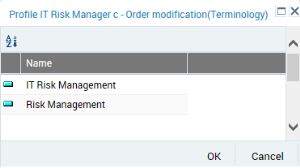
In the example above, the terms of the Risk Management terminology are used when they are not defined in the IT Risk management terminology.
Defining the object types available for a profile
You can define which specific object types are available for a profile:
• document categories
• document models
• Report DataSet Definitions
• widgets
To define the object types available for a profile:
1. Access the properties of the profile.
2. Select the Available Types tab.
3. Select Available Objects.
4. In the toolbar, click New .
.5. In the MetaClassSelection field, in the drop-down list, select the object type category you want to add.
6. In the Short name field, in the drop down list, select the object types to make available for the profile.
7. Click Add.
The object types selected are made available for the profile.