 A campaign enables grouping of several sessions.
You can create an assessment campaign:
• From a template
Creating a campaign from a template allows:
• use of the same template in all assessment sessions.
• definition and planning of sessions by distributing elements to be assessed between different sessions.
• without a template
In the case of creation of a campaign without using a template, a template can be specified at the time of creation of each session.
 This section presents assessment campaign creation using the "Assessment of Requirements by Regulations and Processes" assessment template supplied as standard. Possibilities offered by assessment campaigns without using a template are described in the HOPEX Common Features guide.
To create an assessment campaign:
1. In the Compliance desktop, select Campaign Management > Campaign Management > Execution > Campaigns.
The list of campaigns appears in the edit area.
2. Click New.
The campaign creation page appears.
3. In the Assessment Template field, select "Assessment of Requirements by Regulations and Processes".
4. Modify the Calendar if required.
The calendar serves to initialize begin and end dates of the assessment campaign. 5. Specify the Begin Date and the End Date.
6. Click Next.
7. In the Scope Selection page, select an entity.
The tree automatically expands if the Automatic Expand box is selected.The tree allows you to select requirements assessed in their context.
A requirement is assessed in the context of elements of the branch from the requirement up to the root.
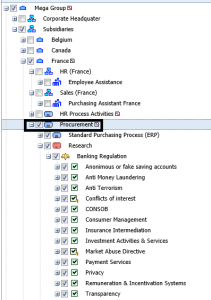
In the above example, if you selected the "Procurement" process, all regulations and requirements located at a lower level are selected, as well as all parent context objects up to the tree root.
If you deselect a node of a branch, only the child elements of this branch are deselected.8. Click Next.
Elements that will be assessed appear in the preview window.
In particular, you can view:
• assessed characteristics (defined in the assessment template)
• assessed objects (requirements)
• context objects (entities, processes and regulations)
• assessment nodes which correspond to requirements placed in their context objects.
Questionnaire respondents are specified later.9. Click OK.