Control Direct Assessment
Direct assessment context
Direct assessment is carried out for all context objects available in the Scope section of control properties:
• Organizational processes
• Business processes
• Entities
 For more details on control contextualization see also Scoping Controls.
Assessing controls
To directly assess a control:
1. Open the properties of a control.
2. Select the Assessment tab, then click Assess.
3. In the wizard that appears, select nodes to be assessed.
 An assessment node comprises:
• an object to assess
• one or several context objects (entities, processes, operations), if necessary
4. Click Next.
You can now select values that characterize this control (contextualized) in terms of:
• design
• effectiveness
Other questions can be asked if your administrator has configured the questionnaire supplied as standard.5. In the Control Design field, indicate whether the control is:
• adequate
• inadequate
6. In the Control Effectiveness field, indicate whether the control is:
• effective
• ineffective
Values are applied to all selected assessment nodes.7. Specify the measure date in the calendar.
By default this is today's date. You can select a date earlier than today's date.
8. Click OK.
Control measures are created for each assessment node (ie. the control in a particular context).
You can create several measures on different dates in the same way. As you create measures, the list can become lengthy. In this case, it can be useful to group measures by date in order to easily find those that interest you.
To group by date, click the arrow at extreme right of the header of the Date column and select Group by this field.Consulting assessment answers
The manager can view answers entered by the respondent when performing direct assessment. He/she can also decide to modify values calculated from these answers if he/she considers them inappropriate.
To view answers used to calculate assessed characteristics values:
 In the Assessment tab of the assessed object properties, right-click the measurement that interests you and select Display Node.This menu is not available in the context of multiple assessment.
Answers used as the basis for calculation of values appear. They are in read-only only.
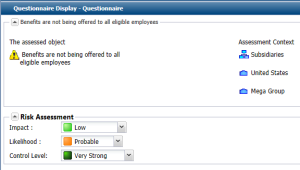
The responsible/manager can decide to modify values resulting from answers.
To modify assessed characteristics values:
1. Open the properties of the assessment you want to modify.
2. Modify values in the Signed Value column for each assessed characteristic value.
These values replace values calculated from answers given by the respondent.
Initial values are visible in the Calculated Value column. The values specified in the Signed Value column are not used in reports supplied by default. You can however call a MEGA professional to include these values in your questionnaires.
Assessing multiple controls simultaneously
If you have to assess several controls, it can be quicker to use the multiple assessment table. This table allows you to specify the same value for several assessment nodes of different controls.
An assessment node comprises:• an object to assess
• one or several context objects (entities, processes, operations), if necessary
To assess multiple controls simultaneously:
1. Select Control Library > Direct Assessment > Multiple Assessment Table.
2. Click Connect Controls to be Assessed.
The wizard that appears proposes a tree of entities to which processes and controls are attached.
3. Select an entity.
The tree expands automatically and allows you to select objects assessed in their context.
An object is assessed in the context of elements of the branch from the object up to the root.
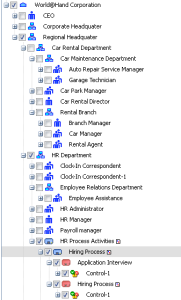
In the above example, if you select the "Manage Human Resources" process, all controls and context objects located at a lower level are selected, as well as all parent context objects up to the tree root.
If you deselect a node of a branch, only the child elements of this branch are deselected.4. Click OK.
The list of controls to be assessed in a particular context appears.
5. In the Control Design field, indicate whether the control is:
• adequate
• inadequate
6. In the Control Effectiveness field, indicate whether the control is:
• effective
• ineffective
7. When values have been specified, select the assessed nodes and click Validate Assessment.
8. Modify the effective measure date if necessary and click OK.
By default the measure date is today's date. You can select a date earlier than today's date.The Control Level is automatically calculated from the specified characteristics.
The control level shows "Pass" if the control is considered to be both:• effective
• adequate
Validation automatically creates an assessment in the Assessment tab of the control properties.
Assessing controls on different dates
You can at any time decide to assess controls that have already undergone a first assessment.
To reassess controls in their context:
1. Select Control Library > Direct Assessment > Multiple Assessment Table.
2. Click Connect Controls to be Assessed.
3. Select from the proposed tree the assessment nodes previously assessed.
For more details, see Assessing multiple controls simultaneously.A dialog box asks you to reselect controls to be assessed.
4. Select Yes.
The previous values corresponding to each assessment node are proposed.
5. Keep these previous values or modify them as required, then click Validate.
6. Enter a date for the new measure and click OK.
The most recent measure values appear in the multiple assessment table.
The different control measures appear in the Assessment tab of the properties of each control.