Specifying Process Behavior
Complying with BPMN standard, a process can have different behaviors. With HOPEX Business Process Analysis, these behaviors are available for organizational processes, operations, system processes and tasks.
To describe for example that a system process is executed by a loop:
1. Right-click the process and select Properties.
The properties windows opens.
2. Click Characteristics.
3. In the Loop field, select the loop type corresponding to process behavior.
4. Click OK.
Shape of the process is modified to display the symbol of the loop.
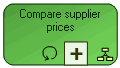
Behaviors proposed are:
• Transaction: a transaction is a set of coordinated activities leading to a consistent, and verifiable outcome.
• Loop: a loop is a process step that is repeated as long as a condition is true.
• "Do while": the condition is evaluated before the first execution.
• "Do until": the condition is evaluated after the first execution. In this case, the process step is executed at least once.
The predicate enables specification of the loop execution condition.
• Ad hoc: steps of an ad hoc process are not controlled or sequenced in a particular order. Their performance is determined by the performers of the process.
• Multiple: the process is repeated a predefined number of times, evaluated only once before it is carried out. Execution type can be specified:
• "Parallel": all executions carried out simultaneously.
• "Sequential": executions carried out one after the other.
• Compensation: a compensation defines the set of activities that are performed during the roll-back of a transaction to compensate for activities that were performed during the normal flow of the process.
Task type
To specify the type of a task:
1. Open the properties of the process.
2. Click Characteristics.
3. Click the arrow at the right of the Type Type field.
A list of task types appears.
• Call Process: task used to call a second process while executing the current process.
• Receive: elementary task which waits for arrival of a message from a participant external to the process. When the message has been received, the task is completed.
• Send: task that sends a message to a participant external to the process. When the message has been sent, the task is completed.
• Manual: task executed without the help of a automatic execution engine of a process or IT application.
• Business Rule: execution task of a business rule with a rules engine which processes input data and returns calculation results.
• Script: task executed by a process execution engine. The designer defines a script in a language that the engine is able to interpret. When the task is ready to start, the engine executes the script. The task is completed when script execution is completed.
 Shape of the process is modified to display the symbol associated with the task type.
Compensation description
Compensation is caused by an event occurring during process execution. This event is placed at the edge of the interrupted process. It can be moved along the edge of the process.
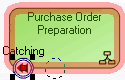
To free the event from the process, use the detach command in its pop-up menu.
This event can trigger a compensation operation.
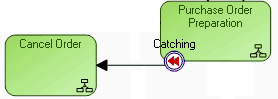 For reasons of consistency and simplification, the compensation link is represented in HOPEX by a sequence flow. BPMN standard proposes a specific link.