Typical deployments
The Windows Front-End can be deployed in different typical deployment:
• Standard deployment
• Citrix/TSE deployment
It is of course also possible to install Windows Front-End on a standalone machine (Stand-alone deployment).
|
Deployment type
|
Recommended for
|
Comment
|
|
Standard deployment
|
Small or medium deployment with good network performances (LAN, VPN)
|
No TSE/Citrix license required.
2-tiers architecture:
• Windows clients (presentation and business logic).
There are as many clients as end user workstations. • Database server (data).
A shared configuration folder is used.
|
|
Citrix/TSE deployment
|
Large deployment, reduced bandwidth
|
3-tiers architecture:
• Client (presentation).
• Application server (business logic).
• Database server (data).
A shared configuration folder is used.
A server farm enables scalability, load balancing, centralized administration and deployment
|
|
Bandwidth / user *
|
2 - 50 concurrent
users
|
More than 50 concurrent
users **
|
|
> 5 Mbit/s
|
Standard deployment
Citrix/TSE deployment
|
Citrix/TSE deployment
|
|
< 2 Mbit/s
|
Citrix/TSE deployment
|
Other deployment models – For specific requirements, other deployment models are possible. For further information, contact your sales representative.
* Bandwidth considered is the bandwidth available between Windows client and database server (RDBMS storage) or file server (GBMS storage).
** Above 50 concurrent users, we recommend a specific study to confirm that the deployment type and the administration procedures are appropriate for project activity and the technical architecture used.
Standard Deployment
There is one MIK (running instance of HOPEX Kernel) per workstation running Windows Front-End.
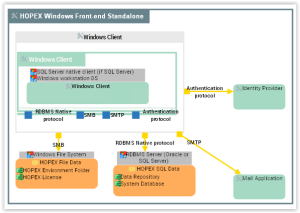
In this example, it is assumed that the repository storage is RDBMS (Oracle, SQL Server). SQL Server Native client is required only with SQL Server storage.
Citrix/TSE Deployment
There is one MIK per TSE/Citrix session running Windows Front-end.
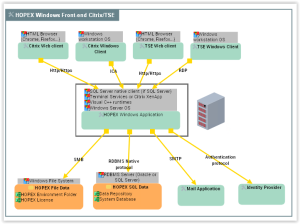
In this example, it is assumed that the repository storage is RDBMS (Oracle, SQL Server) and there is only one Citrix/TSE server. To facilitate readability, the SQL Server Native client required for SQL Server storage is not displayed on the Application Server.