Detecting Conflicts
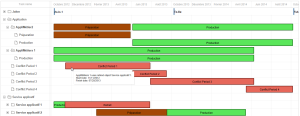
The Gantt diagram of a master plan offers a dynamic view of conflicts of the described diagram.
Conflicts detection example
Included in the example below are the milestones of the two sub-master plans (applications master plan and IT services master plan). At each sub-master plan milestone and for each object type (applications and IT services), the planned objects and their state are presented.
For applications, periods of conflict arise. Passing the mouse cursor over a period of conflict, a message informs you of the inconsistency. Below, the period of conflict indicates that the application depends on a IT service that is not available.
Conflicts detection operation
In a Gantt chart, HOPEX Planning checks that arrangement of periods relating to planned elements is consistent. This consistency depends on links that connect elements of the diagram. In a plan that includes applications and application services for example, the tool considers that the application services connected to the described applications must be available on the same dates as these.

The query can be recursive, ie. if an element A uses an element B and B uses C, if A is available then C should also be available.
Cases of conflict can arise if:
• The application is in preparation and the service in retirement.
• The application is in production and the service in preparation.
• The application is in production and the service in retirement.
• The application is in production and the service in an undefined state (there is no time period indicating service state at the same moment in time).
Below are Type of element that can describe a Master Plan and the Links analyzed for detection of conflicts by Product:
With HOPEX Architecture in addition to HOPEX Planning:
• Capability/resource architecture: composition of Capability and sub-configuration of Capability.
• Resource Architecture/Communicating Physical Resource:element of architecture adopted and resource deployed.
• Artifact/Application: hosting of adopted application and hosted application.
• Application/Artifact: required artifact.
• Application/Application: application of internal architecture.
• Application/IT Service: IT Service of internal architecture.
• IT Service/IT Service: IT Service of internal architecture.
• Application/Technical Infrastructure: Required Technical Infrastructure.
• Technical infrastructure/technical infrastructure element: infrastructure element.
With HOPEX Business Process Analysis in addition to HOPEX Planning: conflicts detected are between processes or related to org-units, applications or services used via notions of Participant or Service Used.
• BPMN Process/Participant: Internal participant.
• BPMN Process/Owned BPMN element: Owned element.
An owned BPMN element can be one of the following types: Contextualization, Shared object, Event, Gateway, Message flow, Offer, Participant, Sequence flow, System used.
• Participant/Participant: Contained participant.
• Participant/Participant element: Assignment.
• Participant/BPMN element: BPMN element.
A BPMN element can be one of the following types: Business process, Event, Functional activity, Functional process, Gateway, Operation, Organizational process, System process, Task.
• Message flow element/Message flow: Target element.
• Message flow/Message flow element: Source element.
• Functional process/Functional activity: Owned functional element.
• Functional activity/Functional process: Functional process called.
• Organizational process/Operation: Owned operation.
• Operation/Organizational process: Organizational process called.
• System process/Task: Owned task.
• Task/System process: System process called.
• System element/System used: System specification.
A system element can be one of the following types: Application, Functionality, Application service, Resource.
• Element using system/System used: System used.
An element using a system can be one of the following types: Business process, Functional activity, Functional process, Operation, Organizational process, System process, Task.
With HOPEX TOGAF in addition to HOPEX Planning:
• TOGAF Decomposition Element/TOGAF Decomposition Element: Comprise Of (used for TOGAF element decomposition).
• TOGAF Information System Service/TOGAF Logical Application Component: ISS Is Realized Through.
• TOGAF Logical Application Component/TOGAF Physical Application Component: Is Realized By.
• TOGAF Realization/TOGAF Physical Technology Component: Realized By.
• TOGAF Platform Service/TOGAF Logical Technology Component: Is Supplied By.