Performing an Advanced Search
Advanced searches are searches carried out by means of queries, either:
• with the help of a wizard
• via a registered query
• by manual entry of query parameters

To execute searches in the form of queries, you must know the names of the object types handled, and be familiar with query syntax, see
"Query Syntax".
Starting the Advanced Search Tool
To start the advanced search tool:

from you Enterprise Architecture desktop (MEGA Web Front-End), click

of the
Query tool.
from the query toolbar, click
Advanced 
.
from an object property pages, click
Connect then
in the
Connecting window click
Query .
The advanced search tool appears.
Advanced Search Tool Overview
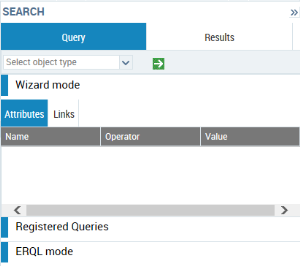
The advanced search tool comprises:
• a Query tab, to configure an advanced search using:
• a wizard
• a registered query
• a query in ERQL language
For more information on ERQL language (query syntax and conditions), see
"Query Syntax".
• a Results tab, to consult simple or advanced query results. From these results, you can:
• search for available reports
• view properties and access diagrams that describe and/or contain each object
• access linked external applications. These options appear when you select one of the objects displayed in your result list.
Performing an advanced search with the wizard
With Wizard mode, you can execute more detailed searches. Detail can relate to:
• object attributes and/or
• Object properties
To perform an advanced search with the wizard:
1. Open the advanced search tool.
The advanced search tool appears.
2. In the Select Object Type drop-down menu, select the object type to which your search relates.
3. Click the Wizard mode pane.
4. (Optional) In the Attributes tab, specify the operator and value defining the attribute to which the search relates:
• Click in the Operator field of the attribute to which the search relates and select the required operator.
Attributes in the drop-down list come directly from
MEGA and exist in English only.
With the "Like" operator, the result contains the specified value,while with the "=" operator, the result is exactly the specified value.
• Click in the Value field of the attribute and enter the character chain to search for.
Each specified
Operator or
Value is highlighted by a small red triangle at top left of its cell.
5. (Optional) Configure another attribute, repeat step
4.
6. To include link conditions in your search, select the Links tab and specify the link characteristics to which the search relates.
• In the
Links tab, specify as in step
4 the
Operator and
Value fields of the link to which the search relates.
• (Optional) Configure another link, repeat step
6.
7. Click
Find 
to start the search.
The list of results appears in the Results tab.
8. Select the object you want to consult.
Properties of the object appear in the read/edit area.
Performing an advanced search on a registered query
You can perform a search on registered queries linked to an object, and run the query.
To perform an advanced search from a registered query:
1. Open the advanced search tool.
The advanced search tool appears.
2. In the Select Object Type drop-down menu, select the object type to which your search relates.
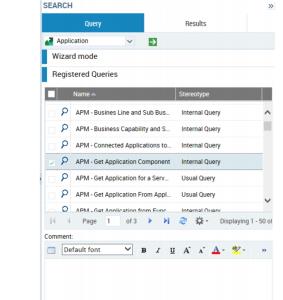
3. Click the Registered Queries pane.
The list of registered queries relating to the selected object appears.
4. Select the query that interests you.
In the Comment tab, the comment associated with the query is displayed (if a comment exists).
5. Click
Find to run the query.
Performing an advanced search in ERQL mode
To perform an advanced search in ERQL mode:
1. Open the advanced search tool.
The advanced search tool appears.
2. In the search tool, click the Query tab.
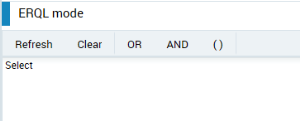
3. Click the ERQL mode pane.
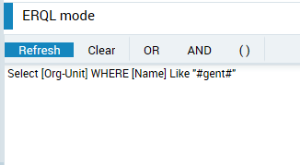
4. Enter a query.
See
"Query Syntax".
Example: "Select Org-Unit Where Name like "#agent#" finds org-units whose name contains agent.
5. Click
Find to start the search.
The list of results appears in the Results tab.
6. Select the object you want to consult.
Properties of the object appear in the read/edit area.
To simplify data entry, you can build a query from properties selected in the wizard:
1. In the Select Object Type drop-down menu, select the object type to which your search relates.
2. Select the query parameters in the Wizard mode.
3. When you have selected your parameters, select the ERQL mode pane.
4. In the command bar of the
ERQL mode pane,
click

.
The syntax of the search query appears.
5. Complete the syntax.
6. Click
Find to run the query.
The list of results appears in the Results tab.
7. Select the object you want to consult.
Properties of the object appear in the read/edit area.