The NOV-6c Report Template
The NOV-6c Report Template supplies reports to detail organizational process implementation. It is defined with three parameters:
• The Architecture parameter, which specifies the architecture to be analyzed.
• Interaction Scenario Subset parameter, which is optional. This parameter is set with Interaction scenarios and is used to reduce the scope of the study. If no value is set for this parameter, all the interaction scenarios are taken into account for the report.
• The Organizational Process Subset parameter, which is optional. This parameter is set with organizational processes and is used to reduce the scope of the study to those selected. If a value is not set, all the organizational processes are taken into account.
The NOV-6c Operational Event-Trace Composition Hierarchy Chapter
This chapter shows the hierarchical structure of the organizational processes through their operations.
 The selected organizational process mentioned within a structure are not reconsidered when starting a new structure (to avoid redundant listing).
The tree structure displays the name and comment of each organizational process in a table.
The NOV-6c Operational Event-Trace Specialization Hierarchy Chapter
The NOV-6c operational event-trace specialization hierarchy chapter shows how the organizational processes of the architecture are specialized.
The organizational processes are presented in a table along with their comments and the library to which they belong.
If a variant of an organizational process is created, the varied organizational process is presented in the table along with its variant.
To create new specializations (variants), use the New > Variant command on the organizational process to be varied (specialized).The NOV-6c Operational Event-Trace Generalization Hierarchy Chapter
The NOV-6c operational event-trace generalization hierarchy chapter shows how the organizational processes of the architecture are generalized.
The organizational processes are presented in table form along with their comments and the library to which they belong.
If a variant of an organizational process exists, this variant is also presented in the table along with the varied organizational process (organizational process from which the variant was created).
To add a new generalization, use the Connect > Variant Of command of the specialized item (variant).The NOV-6c Operational Event-Trace Dictionary Chapter
This chapter lists all the organizational processes with their details and all the interaction scenarios that are examples of how the architecture behaves from an operational perspective. These items are listed with their name and comment.
A paragraph is added for each organizational process which has at least some components or a describing diagram. The title of the paragraph is the name of the organizational process. This paragraph contains the comment, the list of involved components and the (commented) diagram.
Paragraphs are similarly generated for each interaction scenario.
The NOV-6c Operational Event-Trace Exchange Chapter
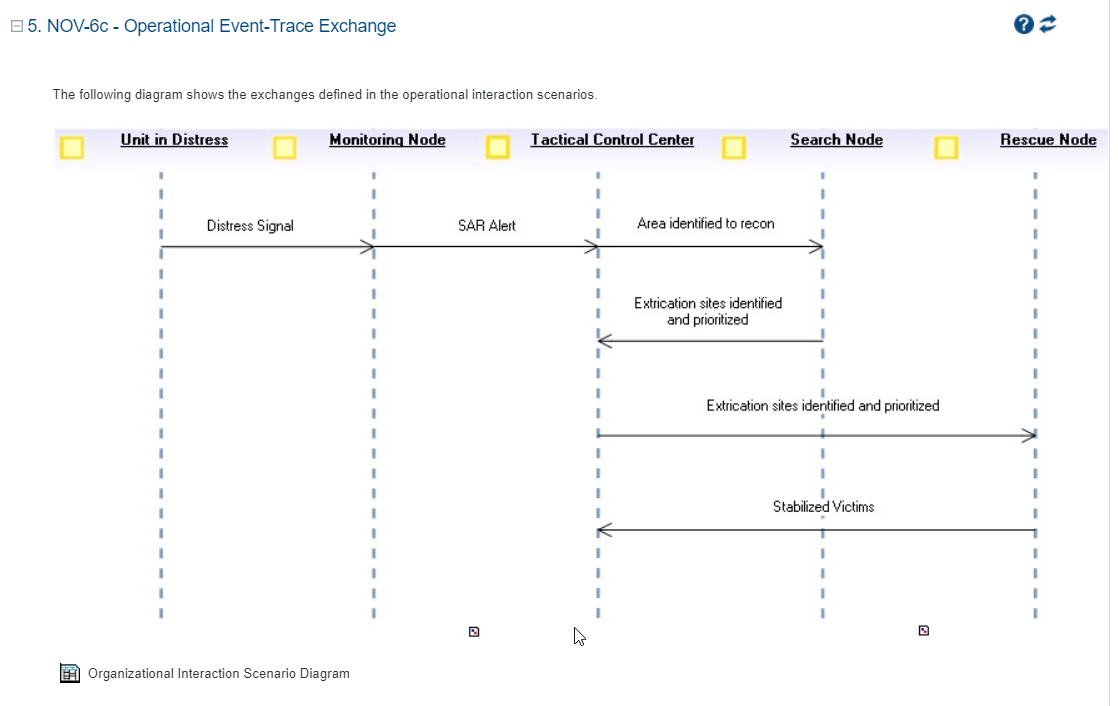
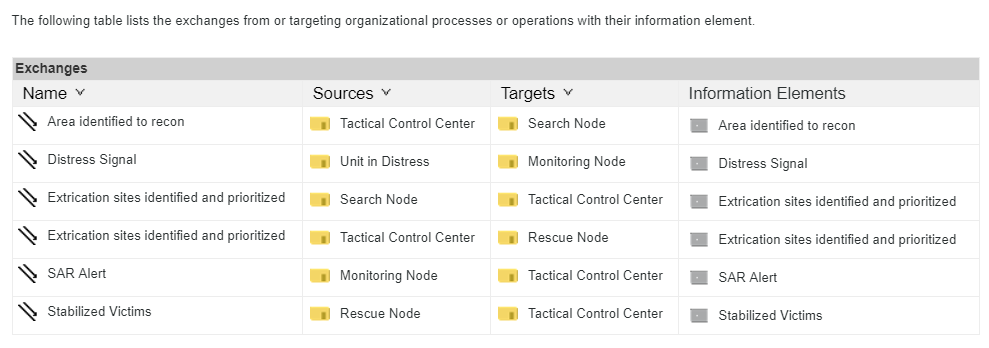
This chapter is used to show the exchanges that occur between organizational processes and operations in the architecture.
It displays operational interaction scenario diagrams:
The exchanges are detailed in a table:
The NOV-6c Operational Event-Trace Exchange Balance Chapter
This chapter is used to show the balance between the exchanges defined within an organizational process and the exchanges it receives and/or sends out.
It lists all the internal and outside messages and interactions that detail the selected organizational process.
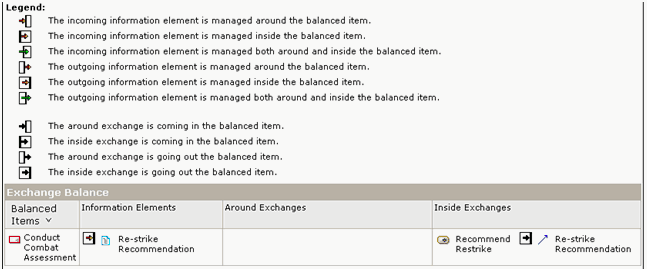
Example of an NOV-6c Operational Event Trace Exchange Balance Chapter