Aggregation Rules
Aggregation rules enable computation of parent node values from their children using computation macros. Several rules are predefined, for example: max, min, sum, average and use Plug-ins supplied as standard. The Type Macro rule must be associated with a plug-in specifying value calculation.
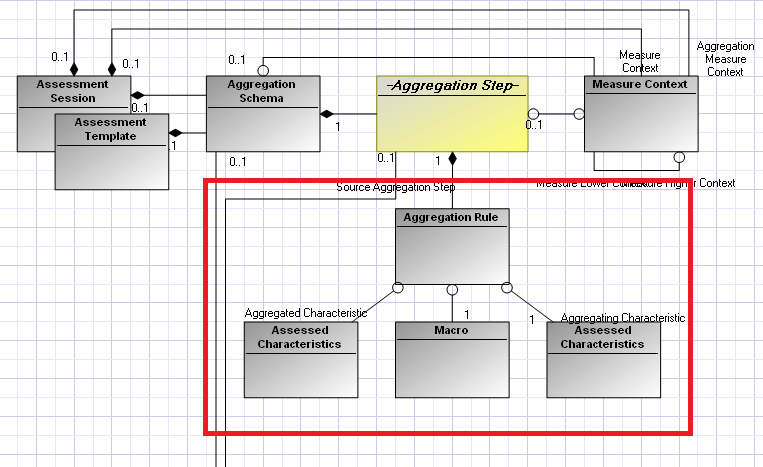
There are five modes to compute Aggregation Values:
- Average: This macro puts on the parent Assessed Value the average of values from its children.
- Max: This macro puts on the parent Assessed Value the max of values from its children.
- Min: This macro puts on the parent Assessed Value the min of values from its children.
- Sum: This macro puts on the parent Assessed Value the sum of values from its children.
For these four standard macros, if the Assessed Characteristic is linked to an enumeration MetaAtrribute, a MetaAtrributeValue of this MetaAtrribute is linked to the Assessed Value to compute.
Example:
If the MetaAtrribute have three MetaAttributeValues X, Y and Z with respectively these internal values x,y z (x<y<z)
If the value computed is d then if:
d<=x => MetaAttributeValue to connect: X
x<d<=y => MetaAttributeValue to connect: Y
y<d<=z => MetaAttributeValue to connect: Z
z<d => MetaAttributeValue to connect: Z
- Macro: Used when the IP want to customize his computation. The macro must have this signature:
Sub aggregationRuleCompute(mgobjAggregationRule As MegaObject,mgobjOutAssessedValue As MegaObject)
End Sub
mgobjAggregationRule: The current Aggregation.
mgobjOutAssessedValue: The Assessed Value to compute.
Other parameters as the assessment node, Assessed Characteristic, or Assessment Session can be got from these two parameters.