Concept structure diagram
In HOPEX Data Governance and HOPEX Data Architecture, a concept structure diagram assembles all information relating to the concept. This diagram is initialized from concept diagram elements.
For example, "Subscriptions" can be classified by "Type of Subscription".
A "Type of Subscription" is characterized by a "Type of Loan".
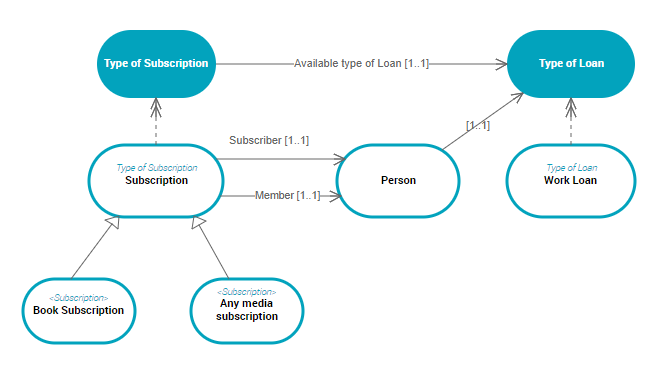
The diagram includes:
• variations between components
For example, "Subscriptions" can be classified by "Subscription Type". A "Subscription Type" being characterized by a "Loan Type".
 A variation describes how a concept can be varied under another form. The variant is an object similar to the varied object, but with properties or relationships that may differ.
 For more details, see Defining Inheritance of a Concept Component.
• Substitutions between components
A substitution determines which element can be used to replace another, or is effectively replaced by an element existing in a given context (for example in the context of a variation). Unlike a variation, a substitution does not involve inheritance but a functional equivalence.For more details, see Creating a Concept Component Substitution.• Concept components describing the relationship between two Concepts
For example, a "Subscription Type" is characterized by an "Available Loan Type".
A concept component enables representation of a dependency relationship between two concepts. This relationship is directional.For more details, see Concept Components.• Concept power components enabling concept characterization from Concept Types
For example, each member "Person" could be characterized by a "Loan Type".
A concept power component enables connection of a concept to concept type to characterize a property of the concept.For more details, see Describing Concept Type Variations.• start events, intermediate events and end events enabling definition of events contributing to change of state of a concept,
For example, the change of state of a member can be caused by a birthday.
An event concept represents an event occurring during concept life, for example a change of season. An event concept marks the impact on a concept of a phenomenon internal or external to the concept. Concept events can be distinguished as concept start events, end events and intermediate events.For more details, see Describing State Concepts.