Modeling Databases
A database is the physical object that enables storage and organization of logical data for use by programs corresponding to distinct applications, to facilitate the independent evolution of the data and the application programs.
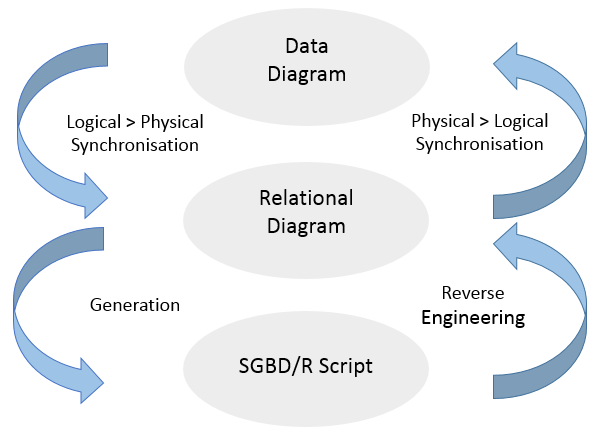
HOPEX Data Governance and HOPEX Data Architecture integrate the logical and physical modeling levels and allow to switch from one model to another. You can therefore:
• Build a data diagram or a class diagram, See Defining Logical Data.
• From this diagram, create database tables and their columns, indexes, and keys, as well as the drawings for the corresponding relational diagrams. See Synchronizing logical and physical models.
• Optimize the resulting relational model and generate SQL commands to define the tables. HOPEX Data Governance and HOPEX Data Architecture in particular take account of changes in the conceptual model without losing optimizations made to the relational model. See Denormalizing logical and physical models.
• Reverse generate a database definition using the ODBC protocol to create the corresponding tables and columns in HOPEX Data Architecture, and obtain the corresponding data diagram or class diagram. See Reverse engineer tables.