Resource Architectures Example
Modeled system general architecture
The following diagram describes general architecture of the support center.
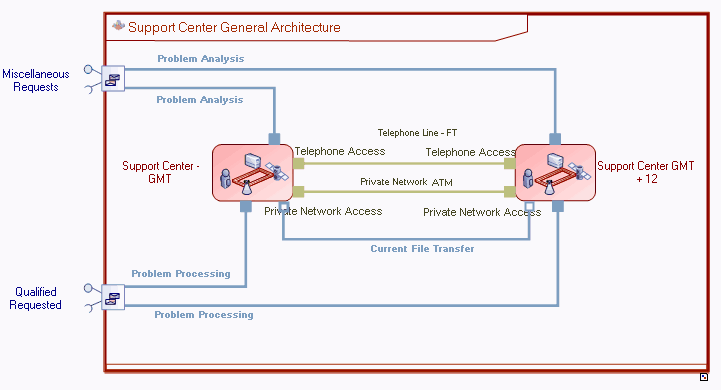
24/24 cover is assured by two "Support Center" teams, one in Paris (GMT Support Center) and the other in Singapore (GMT+12 Support Center). Each of these assures 12 hour support service.
At the end of its service period, each center transfers dossiers to the center taking over.
One support service handles customer requests in real time, while a second support service is assured offline for requests already qualified.
The components of the resource architecture are described in a resource architecture diagram.
The diagram includes:
• two elements of Architecture Use type representing the two support centers.
• two Service Points representing the two support services offered by each of the centers.
• Interactions between the service points and the centers, representing service requests on the one hand and transfer of current dossiers on the other.
• Communication Channels between the two centers.
Support Center Architecture
From the general architecture of the system, you can access the resource architecture diagram that describes the structure common to the two support centers.
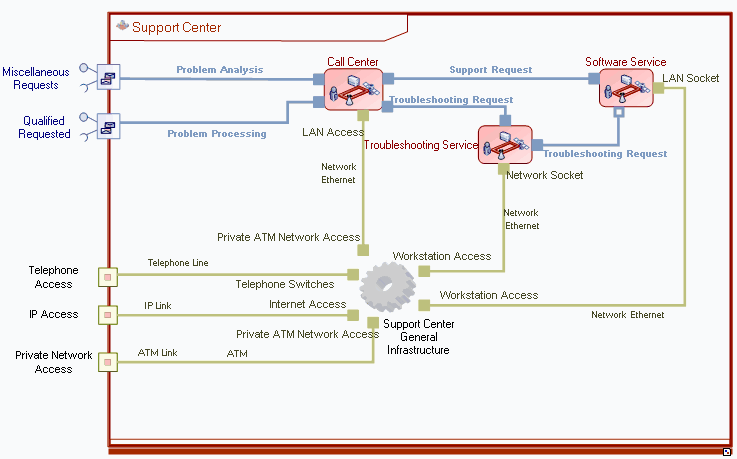
The call center handles all requests, qualified or not, checks these and sends them either to software support or to the troubleshooting service.
If software support detects an operating problem due to equipment, it records the incident and alerts the troubleshooting team.
The three structures depend on the same general hardware infrastructure.
This diagram includes the following equipment resources:
• Physical Assets.
• Communication Ports which represent physical communication points of the equipment architecture and which implement the service points.
• Communication Channels between the two centers.
Call center architecture
The resource architecture diagram of a call center describes the equipment and organizational resources required for handling service requests.
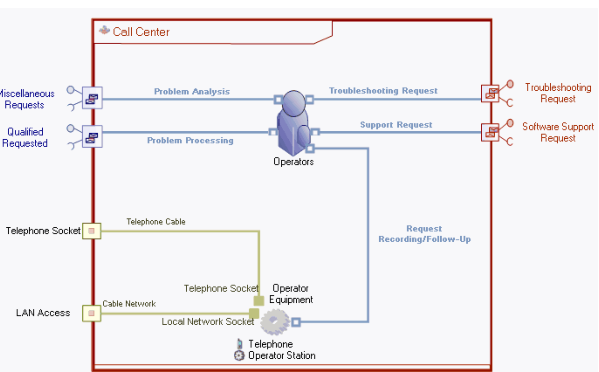
A team of operators handles all requests, whatever their nature, by telephone or by e-mail.
The operator identifies the caller, records the request, applies a first filter (in case of error) and transmits the call to software support or troubleshooting support as appropriate via request points.
We assume for simplification that each team comprises a manager and various members, for whom we do not describe specialization level or duty time slot.
This diagram contains two Request Points from which the operators make service requests to other resource architectures.