Basic AAD Concepts
Within described scope, the AAD shows:
• the described application or the main applications of which interdependencies are being studied.
• the Information flows exchanged by the applications and any associated timers.
• the sites where applications run.
An application can involve several sites. For example, a client-server application can run distributed processes, and an application can also be installed at several enterprise sites. Note that an application can be split into sub-applications.
• the databases consulted or updated by applications. Note that the sites where these databases are installed and the machines that use them are indicated.
• the org-units outside the organization (such as customers and suppliers) that send or receive messages (information flows) to and from the applications.
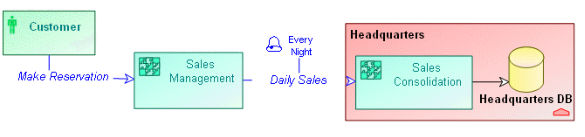
• the interfaces between the applications, the information flows, and the consulted and updated databases.
• information exchanged between databases if these exchanges (file transfers, database replications) are performed by small applications.

• the services used by applications to perform activities such as transferring data from one database to another.
Organizational elements: the org-units
The AAD can also include organizational elements such as the external and internal org-units that use applications, and the messages they send or receive.

Hardware and technical elements: servers and workstations
The AAD can be enhanced with technical elements that enable adequate dimensioning of machines and networks.
You can indicate the server where an application or a service runs, the geographical location of the site where this server is installed and the database(s) found on this server. When you know which applications run on a server, you are better able to choose the correct configuration for this server and decide what type of computer you need, as well as its operating system, memory and hard disk capacity.
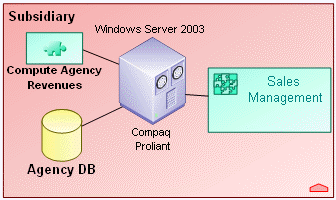
When you define the workstations, you are describing the computers assigned to the org-units. You can indicate which applications and databases are to be run on each workstation. This information allows you to make the correct choice in workstation configurations.
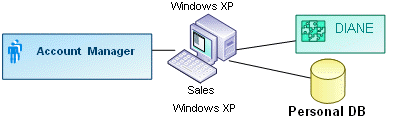
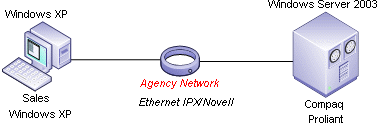
You can also specify the network that connects these different computers.
Specialization
Specializations allow you to distinguish between particular cases of the same message. Certain operations are valid for the general case known as super-type: for example, all the orders sent by a customer. Other operations (sub-types) will be used only in specific situations. For example, orders placed using e-mail are processed differently from orders placed by fax.
An order placed by a customer is processed differently depending on whether it is urgent or not.
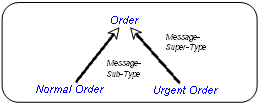
Specialization of messages
You can indicate sub-types for org-units, sites and messages.
Distributed processing
You can distribute processing between a client application and a server application. You can also indicate which services on the application server are used by the client.
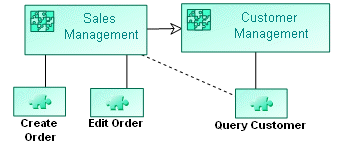
Distributed processing
Inter-site Analysis
These are the links required or already existing between the sites.