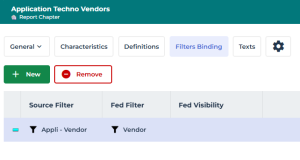
Report Chapter Properties
From the Report Chapter properties you can access information regarding:
• its Characteristics,
• its Definitions (specific to Report Chapters based on Report Data Views),
• its Filters Binding (specific to Report Chapters based on Report Data Views).
Characteristics
In Characteristics:
• You can define whether the Report Chapter can be exported in:
• Excel format (Is compatible with Excel)
• RTF format (Is compatible with RTF)
When selected, fonts used in the RTF texts of objects (e.g.: comment) are kept in web site generation. Else, a CSS file should manage the font choice depending on each HTML tag class.
• _GUIName: you can define the name you want to be displayed for the Report Chapter.
• (for a Report Chapter based on a macro) Implementation section: defines on which macro the Report Chapter is based.
• Snapshot section: you can define a snapshot for a fast Report Chapter display. The snapshot is also used for export operations.

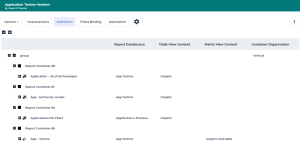
Definitions (Report Data Views-based Report Chapters)
Definitions shows:
• a global view of the Report Chapter constituents and structure (as a tree view)
• how each of its following constituents are displayed:
• (if any) Container Group: horizontal, tab or vertical.
• Report Data View: table, graphic, or table and graphic.
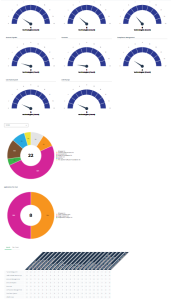
For example, the "Application Techno Vendors" Report Chapter includes four Report Data Views showing three graphics (a set of gauges and two pie charts) and a matrix one above the other (Container Organization of the group: "Vertical")
Filters Binding (Report Data Views-based Report Chapters)
A filter enables to restrict a Report DataSet column values, which are considered in the report. This Report DataSet column is not necessarily part of the report.
Filters Binding enables to feed a filter content with another filter content. Both filters must be of the same type.
To do so you need to create a binding object.